

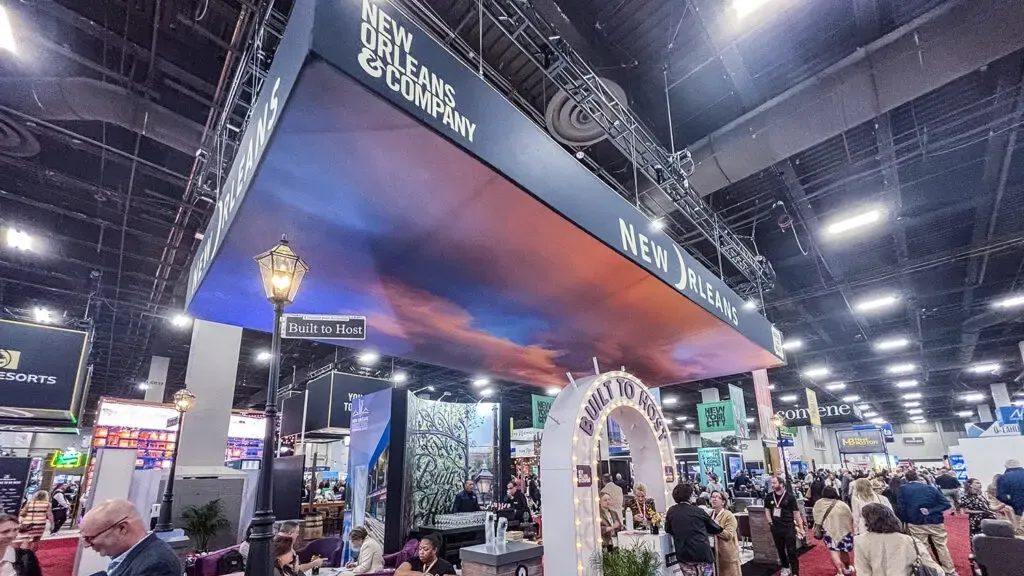
New Orleans does not do forgettable.
Your exhibit should not either.
On a crowded show floor, attention is only the first job. The booth must help the right visitor understand the brand, enter the space, experience the product and begin a useful conversation.
That outcome depends on more than attractive walls. Message, visitor flow, utilities, technology, freight and installation must work as one plan.
Purple Exhibits designs, fabricates and manages custom, rental and hybrid exhibit programs across the United States, including New Orleans, supported by Purple’s New Orleans exhibit services.
The goal is simple: your team walks into a finished booth, not a construction project.
Quick Answer: What Does It Take to Exhibit Successfully in New Orleans?
Successful New Orleans exhibiting starts with one coordinated plan for booth design, the current show manual, venue services, freight, utilities, labor and move-in. Many custom booth projects need about 8–12 weeks after the direction and scope are clear; large activations, rigged structures and complex technology should start earlier. Assign an owner to every approval, order and handoff, then work backward from the event’s move-in date and discount deadlines.
In This Guide
- Planning for the Morial Convention Center
- Reviewing upcoming New Orleans trade shows
- Choosing a custom, rental or hybrid booth
- Building the complete show budget
- Assigning responsibility for show services
- Planning freight, drayage and move-in
- Working backward from move-in
- Evaluating an exhibit partner
- Using the readiness checklist
Start With the Job Your Booth Must Do
Before selecting materials, screens or lighting, decide what success needs to look like.
Are you launching a product? Meeting distributors? Demonstrating equipment? Hosting scheduled conversations? Building brand awareness? Collecting qualified leads? Creating an experience people will photograph and share?
Different goals require different booths.
A product launch may need strong long-distance branding and a presentation area. A technical exhibit may require powered demonstration stations, secure storage and careful cable management. A relationship-driven show may need an open welcome area plus quieter meeting space. A high-traffic consumer activation may need multiple entry points and a layout that keeps people moving without making the experience feel rushed.
The strongest booth design begins with five decisions:
- Who needs to stop? Define the audience that matters most.
- What should they understand in five seconds? Build one visible message hierarchy.
- What should they do next? Make the desired action obvious.
- What must happen inside the booth? Plan demonstrations, conversations, hospitality, presentations and storage before styling the space.
- How will success be measured? Choose useful outcomes such as qualified meetings, demonstrations completed, opportunities created or follow-up actions—not traffic alone.
Pretty matters.
Performance pays.
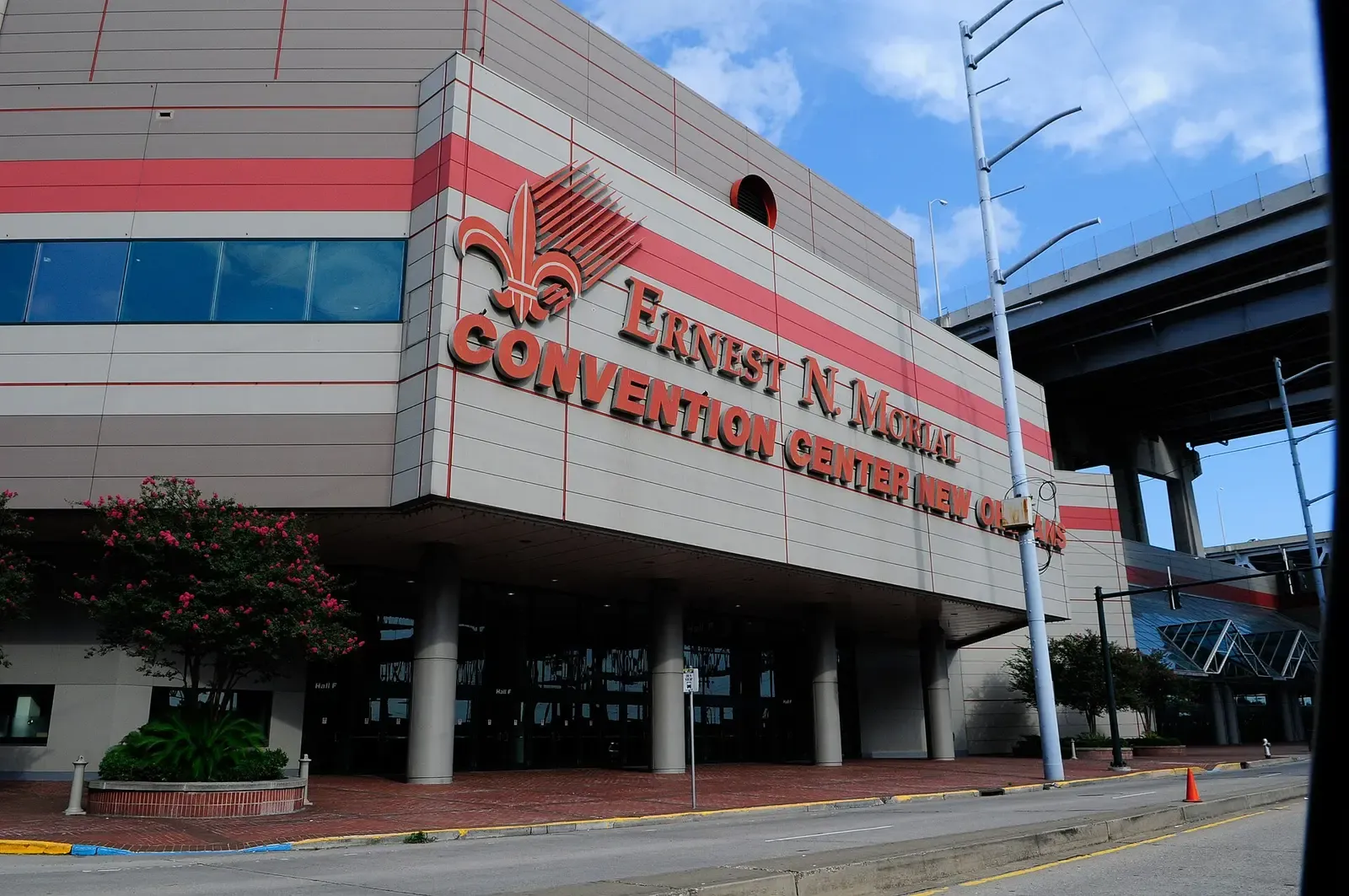
Planning a Booth at the New Orleans Ernest N. Morial Convention Center
The New Orleans Ernest N. Morial Convention Center reports 1.1 million square feet of prime exhibit space on one level and under one roof. That scale creates opportunity, but it also changes how an exhibit must work.
Official MCCNO Exhibitor Links at a Glance
Use the current event manual as the controlling source for show-specific deadlines and procedures. These official venue resources answer the most common facility questions:
Long aisles make sightlines important. Large halls make clear landmarks valuable. Busy entrances can generate traffic without generating engagement. And a booth that looked bold on a laptop screen can feel surprisingly quiet once it is surrounded by hanging signs, LED displays, product demonstrations and thousands of attendees.
Design for the actual hall, not an empty white rendering. Review the venue’s current floor plans and capacities together with the event floor plan, because booth orientation, entrances, neighboring exhibits and service access all affect the design.
That may mean:
- A simple, readable message visible from the aisle
- Strong vertical branding when show rules permit it
- Lighting that creates contrast without washing out screens or products
- Open corners that welcome traffic
- A focal point that gives attendees a reason to stop
- Demonstration zones that do not block the entrance
- Meeting areas positioned away from the busiest path
- Storage placed where staff can reach it without disrupting visitors
The venue also manages important exhibitor services. Its official Exhibitor Services page covers internet, electrical, plumbing and telecommunications ordering. The current MCCNO Rules and Regulations state that the venue is solely authorized to provide utility services and connections to its power sources.
Plan Utilities From the Equipment Backward
Do not guess at power or connectivity from the booth size. Start with an equipment list: screens, processors, computers, lightboxes, chargers, refrigerators, demonstration products, lead-capture devices and anything else that must power up on opening morning. Record the voltage, amperage, connection point and operating schedule for each item. Then map floor ports, cable paths and any labor needed to make the connections safely.
Treat internet the same way. Decide whether each experience needs wired or wireless service, what bandwidth it requires, whether a corporate VPN or firewall could interrupt it and what the offline fallback will be. A beautiful interactive display is still a blank screen when the connection plan fails.
Rigging needs early attention too. Under the venue’s current published rules, exhibitor rigging plans exceeding 250 pounds per hanging point require written authorization at least 60 days before occupancy. Some areas and event types have additional exclusive-service requirements.
Crew access is another separate workstream. MCCNO’s current Facility Access Policies require contractors, suppliers, vendors and exhibitor-appointed contractors to obtain ESCA-WIS credentials. Those credentials do not by themselves grant access to a specific event, so verify the show’s EAC notice, certificate of insurance, show badges, work rules, entrances and crew call times as well.
The practical rule is this: never build a New Orleans exhibit plan from memory. The current show manual, venue rules, booth type and assigned hall must control the final design and service orders.
Major Upcoming Trade Shows in New Orleans
Verified August 24, 2026. Event dates and exhibitor requirements can change; confirm them with the organizer before committing freight, labor or travel.
These listings do not imply that Purple has built at every named show. They identify current New Orleans exhibiting opportunities and the planning questions their product categories commonly create.
Should You Choose a Custom, Rental or Hybrid Booth in New Orleans?
There is no universally “best” booth. There is only the right solution for the brand, the show and the longer exhibit calendar.
A Custom Exhibit
A custom exhibit gives the greatest freedom in architecture, finishes, product integration and storytelling. It can be a smart choice when the booth must communicate a premium position, accommodate unusual products, create an immersive environment or become a repeatable brand asset across important shows.
A Custom Rental Exhibit
A custom trade show booth rental in New Orleans can deliver a high-end, branded presence without requiring the exhibitor to own every structural component. It is often a strong fit for a one-time New Orleans show, a changing booth schedule or a company that wants flexibility without a generic rental look.
A Hybrid Exhibit
A hybrid program combines reusable custom assets—such as signature counters, product displays or branded features—with flexible rental structure. This approach can protect the brand’s visual identity while making it easier to reconfigure for 10×20, 20×20, peninsula or island spaces in different cities.
The right decision depends on more than the initial booth quote. Compare:
- Number of shows and cities in the program
- Expected booth sizes and configurations
- Freight and material-handling exposure
- Storage, maintenance and refurbishment needs
- Level of customization required
- Product and AV integration
- Installation complexity
- How frequently branding or messaging changes
Rental is not automatically basic. Custom is not automatically smarter. The best exhibit is the one engineered around the whole program.
Design for the Way People Actually Move
Trade show visitors do not enter a booth because the floor plan is technically efficient. They enter because something makes the next step feel worthwhile.
That “something” might be a product in motion, a sharp question, an unexpected material, a live demonstration, a bold visual, a comfortable conversation area or a clear promise that speaks directly to their problem.
An effective New Orleans trade show booth should create a simple journey:
See it. Understand it. Enter it. Experience it. Continue the conversation.
Keep the primary message short enough to read while walking. Place the most important product or experience where it can be discovered without creating a bottleneck. Give booth staff room to greet visitors without forming a human wall across the entrance. If you need lead capture, plan where it happens and what the visitor receives in return.
For larger booths, use distinct zones with one connected story:
- Attraction or hero zone
- Product or demonstration zone
- Conversation area
- Private or semi-private meeting space
- Hospitality area, when appropriate
- Staff and lockable storage
- AV control and service access
Every zone needs a reason to exist.
Every transition needs to feel natural.
How Much Does a Trade Show Booth in New Orleans Cost?
There is no responsible single price based on square footage alone. Two booths with the same dimensions can have very different total costs because the design, materials, graphics, technology, freight, labor, venue services and post-show plan may be completely different. Size matters, but scope matters more.
Purple’s current 2026–2027 trade show booth cost guide uses these broad national planning ranges for professionally executed exhibits:
These are educational estimates, not New Orleans quotations. Depending on the proposal, they may include some design, structure, graphics, flooring, furniture, freight coordination and installation. They generally exclude raw booth-space fees, staff travel, sponsorships, major utilities, extensive rigging, complex product integration and significant changes after approval. The event, scope, schedule and service requirements determine the actual project cost.
A realistic New Orleans exhibit budget may include:
- Strategy, booth design and 3D rendering
- Engineering and production drawings
- Custom fabrication or rental structure
- Exhibit graphics, SEG fabric, lightboxes and signage
- Flooring and underlayment
- Furniture and hospitality elements
- Monitors, LED walls, sound and interactive technology
- Product mounting and demonstration requirements
- Freight to the advance warehouse or show site
- Material handling or drayage
- Installation and dismantling labor
- On-site supervision
- Electrical, internet, plumbing and compressed-air services, if needed
- Rigging and hanging signs
- Cleaning and waste removal
- Storage, return shipping or movement to the next show
- Contingency for approved late changes
Ask every potential exhibit partner to separate three things clearly:
- What is included in the exhibit company’s scope?
- What is estimated but billed separately by the venue, organizer or official contractor?
- What is not included at all?
A low booth number can become an expensive show when freight, labor, utilities, graphics or supervision are missing from the conversation. A clear scope is not paperwork for paperwork’s sake. It is how surprises get removed before the dock doors open.
Who Handles Booth Services at a New Orleans Trade Show?
“Turnkey” should mean that one accountable exhibit partner coordinates the approved scope from design through show-floor delivery. It does not mean that one company directly supplies or invoices every venue-controlled service. One of the easiest ways to lose control of a trade show budget is to assume that “turnkey” means the same thing to every company. It does not.
Purple can coordinate the moving parts, but the written proposal and the current exhibitor manual should always identify who supplies, orders and invoices each service.
Use the two-page New Orleans Exhibit Readiness Kit to share this ownership chart, the deadline planner and the pre-ship checklist with your internal team.
How Do Freight and Drayage Work for a New Orleans Trade Show?
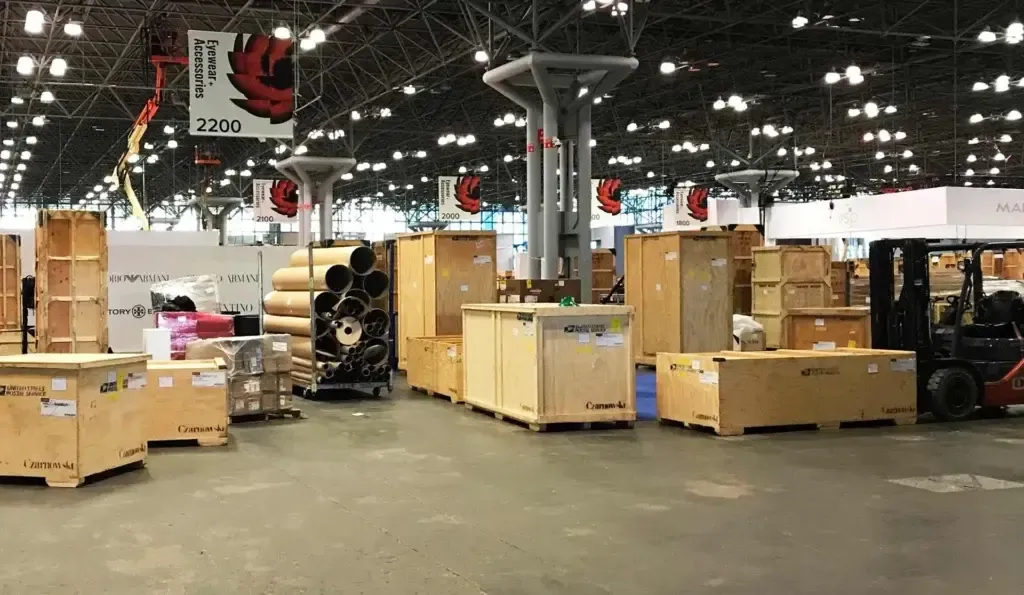
Freight is the transportation of the exhibit to the advance warehouse or show site. Drayage, also called material handling, is the show-appointed movement of that shipment between the receiving point and the booth, including related handling and empty-container processes under the event’s rules. They are connected costs, but they are not the same service.
An exhibit is not show-ready when fabrication ends. It is show-ready when every crate, graphic, screen, fastener and tool arrives at the correct destination in the correct sequence.
For event-specific freight, MCCNO directs exhibitors to use the address and instructions in the official exhibit packet because each general contractor may use a different marshaling yard and check-in location. The venue does not act as an advance warehouse for exhibitor freight. Its Lobby F UPS Store is a business center and small-package resource, not a substitute for the event’s freight system. The venue’s delivery guidance is useful background, but your show manual is the controlling source.
Before shipping, confirm:
- Advance warehouse versus direct-to-show deadlines
- Correct carrier and delivery appointment requirements
- Crate labels on multiple sides
- Booth number, hall and event name
- Piece counts, dimensions and weights
- Marshaling-yard instructions
- Target move-in schedule
- Empty-container labeling and storage process
- Return labels and outbound carrier plan
- Contact information for the person supervising installation
Pack for the installation sequence, not merely for the shortest crate list. The first items needed should not be buried beneath the last items installed. Graphics should be protected and clearly identified. AV equipment, mounts and cables should travel as a tested system. Critical hardware should have documented backups.
The best time to discover that a cable is missing is during pre-show quality control.
The worst time is ten minutes before the client arrives.
Seven New Orleans Exhibiting Mistakes That Get Expensive
- Designing before reading the manual. Height, setback, rigging, fire-safety or booth-type rules can force late redesigns.
- Ordering utilities from a rough guess. Build the order from the final equipment schedule and cable plan.
- Treating the UPS Store as an advance warehouse. Follow the event packet’s freight address and general-contractor instructions.
- Missing the discounted service deadline. Assign every form to a named owner and an internal due date earlier than the published cutoff.
- Packing by convenience instead of install sequence. Load crates so the crew can reach the first-needed components first.
- Leaving crew credentials until move-in. Confirm EAC approval, insurance, ESCA-WIS credentials and show-specific access requirements early.
- Failing to plan outbound freight. Carrier, labels, paperwork and post-show destination should be settled before opening day.
When Should You Start Planning a New Orleans Trade Show Booth?
Many custom booth projects require roughly 8–12 weeks after direction and scope are clear. Larger activations, engineered structures, imported products, complex AV and rigged elements should begin earlier. Your actual schedule must follow the event’s service deadlines and the approved project scope.
The deadline printed in the manual is not the day to start the task. It is the day the completed task must already be submitted.
Print or share the New Orleans Exhibit Readiness Kit before the kickoff meeting so every milestone has an owner.
Questions to Ask Before Choosing a New Orleans Exhibit Partner
When comparing a trade show booth builder or exhibit builder in New Orleans, look beyond the rendering.
Ask:
- Who is accountable from design approval through dismantle?
- Who builds the exhibit, and where is it produced?
- Has the design been evaluated for the assigned space and show rules?
- Who prepares production drawings and coordinates required approvals?
- Who owns the freight plan and tracks the shipment?
- Who coordinates installation labor, utilities, AV and rigging?
- Who will be present or reachable during move-in?
- How are graphics and technology tested before shipping?
- What is included, estimated separately or excluded?
- What happens to the booth after the show?
- Can the assets be reused or reconfigured for the next city?
Judge New Orleans capability by the execution plan. Before the first crate ships, the builder should be able to show you where the exhibit is produced, how freight will be routed, who is assigned to installation, who owns the show-service orders, who leads move-in and how an issue will be escalated. Local execution should be specific, documented and accountable.
Copy This Brief Before Requesting a New Orleans Booth Design
- Event name, venue, show dates, move-in date, booth number and space type
- Booth dimensions, orientation, neighboring aisles and official floor plan
- Primary audience, one-sentence message and the action visitors should take
- Products, demonstrations, meeting, hospitality and storage requirements
- Brand standards, approved assets and accessibility considerations
- Screens, interactive technology, internet, power, plumbing and rigging needs
- Budget range, approval team and non-negotiable deadlines
- Freight origin, reuse plan and next destination after the show
- What the exhibit partner should own, coordinate or price separately
A useful first conversation should end with a defined scope, a responsibility map and the next approval date—not only a rendering request.
Real New Orleans Experience: Amazon at ESSENCE Festival
New Orleans is not theoretical for Purple Exhibits.
For an Amazon experience at the ESSENCE Festival of Culture, Purple designed and executed a large immersive environment with connected zones for Prime Video, Amazon Live, Alexa and community engagement.
The project required more than one impressive view. It required a complete visitor journey. Open architecture supported movement. Individual environments gave each Amazon offering its own identity. Graphics, lighting, finishes and spatial transitions kept the experience connected. Purple managed design, engineering, fabrication, shipping, installation and on-site execution as one program.
See the complete Amazon ESSENCE Festival activation case study.
What the Amazon project reinforced for our team is simple: on a multi-zone activation, every decision crosses into the next trade.
Visitor flow affects walls and entrances. Structure affects lighting, power and AV. Technology affects content deadlines and cable paths. All of it affects crate order and installation sequence.
Managing those interfaces as one project is what keeps a connected experience from becoming a collection of disconnected parts.
How Purple Keeps the Handoffs Accountable
Purple can coordinate exhibit strategy and design, fabrication or rental structure, graphics and technology integration, trade show logistics and shipping, and installation and dismantling. The approved proposal should still state exactly what Purple owns, what the exhibitor must approve and what the show, venue or official contractor supplies or bills separately.
The Purple Handoff
At every major transition—strategy to design, design to production, production to freight and freight to the show floor—confirm four things:
- Approved: Is the scope, drawing or order final?
- Assigned: Who owns the next action?
- Scheduled: What is the internal due date and the external deadline?
- Verified: What proof confirms the handoff is complete?
This is how “full service” becomes visible: fewer assumptions, clearer accountability and a booth that is ready for the client walk-through before the doors open.
New Orleans Exhibitor Readiness Checklist
The downloadable New Orleans Exhibit Readiness Kit combines this checklist with the responsibility matrix and 16-week planning schedule.
Before your booth ships, confirm that you have:
- Approved the final design, scope and production drawings
- Verified booth dimensions, orientation and space type
- Reviewed the current exhibitor manual and venue rules
- Submitted required EAC, insurance, drawing and rigging documents
- Approved every graphic at final size and resolution
- Identified every electrical, internet, plumbing and AV connection
- Confirmed product weights, mounting details and delivery timing
- Ordered required show services before discount deadlines
- Selected advance warehouse or direct-to-show shipping
- Prepared correct freight labels and a complete piece count
- Confirmed installation labor and on-site supervision
- Tested monitors, LED content, interactive media and lead capture
- Prepared staff schedules, goals and follow-up responsibilities
- Scheduled final booth cleaning and the pre-opening walk-through
- Booked outbound freight, storage or delivery to the next show
If several boxes are still open, you do not need more stress.
You need one accountable plan.
Frequently Asked Questions About Exhibiting in New Orleans
How Far in Advance Should I Begin Planning a New Orleans Trade Show Booth?
Many projects need at least 8–12 weeks once the direction and scope are clear. Large custom exhibits, complex technology, engineered structures, hanging signs and experiential activations should begin earlier. The show’s current manual and service deadlines should determine the final schedule.
How Much Does a Trade Show Booth Cost in New Orleans?
Cost depends on the booth size, space type, design complexity, materials, graphics, AV, product integration, freight, material handling, labor, utilities, rigging, supervision and post-show plan. Compare proposals using the same scope and ask what the exhibit company includes versus what the venue or official contractor bills separately.
What Services Does the Morial Convention Center Provide Directly?
The venue’s official exhibitor resources include internet, electrical, plumbing and telecommunications services. Current venue rules govern utility connections and certain rigging services. Always verify the event-specific manual because show organizers and official contractors may add procedures, deadlines and exclusive services.
Does the Morial Convention Center Receive Exhibitor Freight?
Do not ship event freight to the venue using a generic address. MCCNO directs exhibitors to the address in the event’s exhibit packet because the general contractor may use a specific advance warehouse, marshaling yard and check-in process. The Lobby F UPS Store handles packages and business-center services; it is not the event’s advance warehouse.
How Should I Plan Electrical Power and Internet for the Booth?
Create a final equipment schedule before ordering. List the power and connection needs for screens, processors, computers, lighting, appliances, demonstration products and lead capture. For internet, confirm wired versus wireless service, bandwidth, security restrictions and an offline backup. Then map each connection and cable route onto the approved booth plan.
Can Purple Coordinate Show Forms and Service Deadlines?
Purple can coordinate the forms and service orders included in the written project scope, track approvals and maintain a responsibility schedule. The exhibitor should still provide the current manual promptly, approve required information on time and understand which third parties issue the final invoices.
What Information Does Purple Need to Begin Planning?
Share the event and venue, booth number and dimensions, move-in date, goals, audience, products, brand assets, functional requirements, budget range and approval team. The current exhibitor manual and event floor plan are especially valuable because they reveal rules and deadlines that can affect the concept.
Ready to Plan Your New Orleans Trade Show Booth?
Your audience should see a confident brand.
Your team should see a finished booth.
You should not have to manage five vendors, chase freight, troubleshoot screens and wonder whether the graphics will arrive before the client does.
Send Purple the RFP or exhibitor manual, event floor plan, booth dimensions and the result the exhibit must create. We will use them to define the design brief, responsibility map and realistic scope.
Skip the chaos. Just show up.
Discuss your New Orleans booth design and scope with Purple Exhibits.