
If you need to know how to choose a KBIS booth builder for Las Vegas 2027, do not start with the prettiest rendering or the lowest total. Start with what each company can prove, what its proposal actually includes and who will own the project when the freight, utilities, products and labor meet on the show floor.
On opening morning, a rendering cannot fix a missing drain line, a misaligned cabinet or a crate that never reached the booth.
A rendering shows what an exhibit might look like. It does not show who will engineer the structure, receive the products, route water and power, protect finished surfaces, coordinate show services, supervise installation, solve discrepancies or make sure every crate leaves the Las Vegas Convention Center after dismantle.
Those details matter at every trade show. At KBIS, they are often the difference between a beautiful concept and a booth that is actually ready when the doors open.
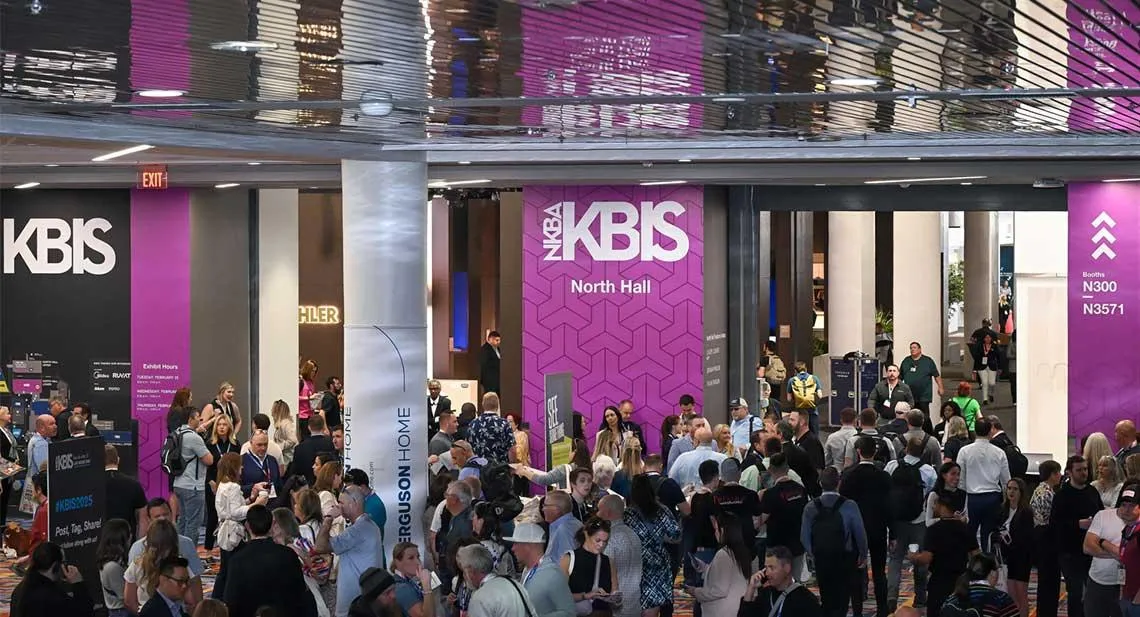
KBIS 2027 takes place February 2–4, 2027, at the Las Vegas Convention Center in Las Vegas, Nevada. The official show describes the Kitchen & Bath Industry Show as North America’s premier kitchen and bath event and reports more than 600 exhibiting brands. It is also co-located with the International Builders’ Show as part of Design & Construction Week.
That means exhibitors are not just competing for attention. They are presenting products to designers, architects, builders, remodelers, dealers, distributors, retailers, media and other people who notice the details.
A KBIS trade show booth is part showroom, part product demonstration, part meeting space and part temporary construction project.
The right KBIS exhibit booth builder must understand all four.
This guide gives exhibitors a practical way to compare KBIS exhibit builders and booth proposals, identify missing scope and select a partner based on evidence—not sales language.
KBIS 2027 at a glance Official event: Kitchen & Bath Industry Show (KBIS) Dates: February 2–4, 2027 Venue: Las Vegas Convention Center Location: Las Vegas, Nevada Decision tool: Purple Exhibits’ 100-point KBIS Booth Builder RFP Scorecard Show facts last verified: August 24, 2026
The Quick Answer: What Should You Look for in a KBIS Booth Builder?
The best KBIS booth builder for your project is the company that can prove relevant experience, translate your products and goals into a buildable environment, define every responsibility in writing and manage the complete path from design through dismantle.
Purple’s evaluation standard is simple:
Proof before promises. Scope before price. Ownership before opening day.
A strong candidate should be able to provide:
- Real photographs and details from completed exhibits—not only renderings
- Experience with products similar to the ones you will display
- Strategic booth design tied to specific business goals
- Engineering and production drawings
- A clear product-integration plan
- Transparent inclusions, exclusions, allowances and assumptions
- A documented fabrication and quality-control process
- A Las Vegas freight, labor and show-service plan
- A named project lead and on-site supervisor
- A defined dismantle, outbound-shipping and storage plan
If a proposal is vague in any of these areas, its bottom-line price is not yet comparable.
Free KBIS 2027 planning resource Evaluate exhibit proposals across 32 weighted criteria, eight qualification gates and 24 scope-ownership lines. Download the Free KBIS RFP Scorecard (PDF) Eight pages · approximately 71 KB · no email required
Download the Free KBIS Booth Builder RFP Scorecard
Use the workbook to compare up to five exhibit companies, apply eight pass-or-fail gates, cap unsupported claims, normalize hidden scope and cost, and create a one-page decision summary.
Both downloads are free and ungated. Use the framework with Purple Exhibits or any other booth builder.
Scorecard version: 1.0 Official sources last checked: August 24, 2026
Cite this scorecard Purple Exhibits. 2026. 2027 KBIS Booth Builder RFP Scorecard, methodology v1.0. https://purpleexhibits.com/kbis-booth-builder-rfp-scorecard/
Who Created This Scorecard—and What It Does Not Claim
Purple Exhibits created this scorecard as a practical procurement tool for complex exhibit projects. Material show-rule claims link directly to current official KBIS exhibitor resources. The framework does not rank builders based on sponsorship, inventory or geography, and no company can receive full credit on claims alone.
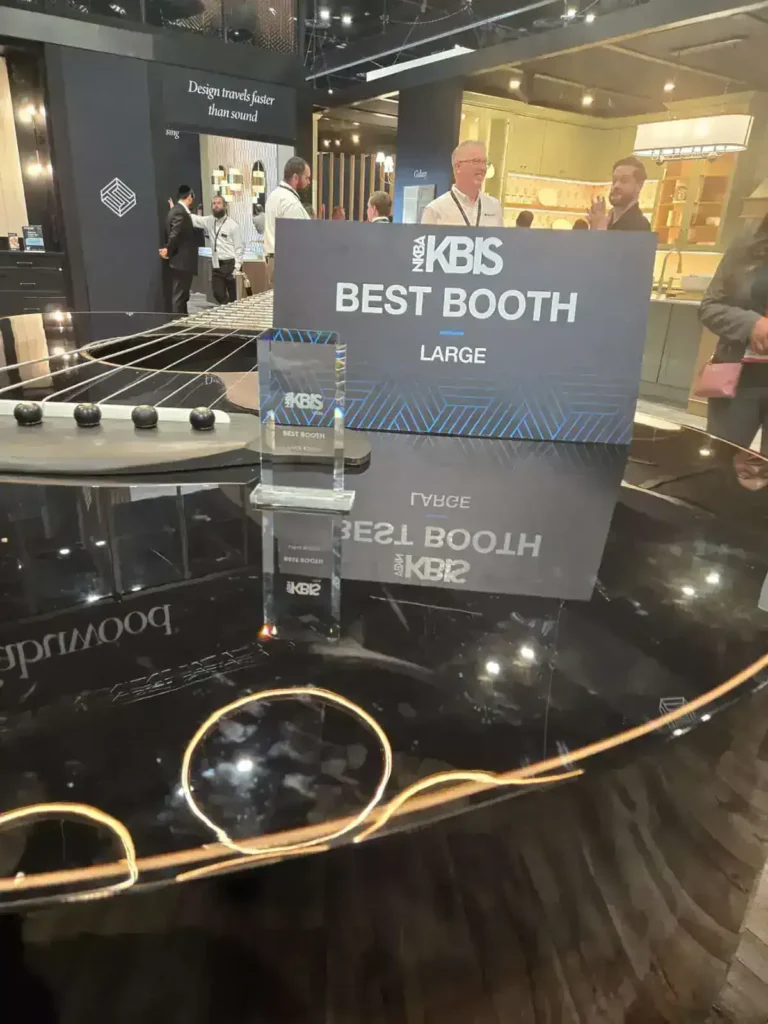
Kitchen & Bath Business documented Fabuwood’s exhibit as a 60 × 50 footprint. Purple’s public KBIS 2026 release states that it provided project management, fabrication, logistics, installation and on-site support. The official KBIS announcement named Fabuwood’s exhibit Best Large Booth; the award belongs to Fabuwood, and this guide does not claim sole design authorship or an overall Best in Show award.
Commercial-interest disclosure: Purple Exhibits is a commercial exhibit company and may be one of the builders considered by readers. This scorecard does not rank or endorse any exhibit company, accepts no payment for inclusion and applies the same evidence caps, criteria and pass-or-fail gates to Purple Exhibits as it does to every other bidder.
How This Framework Was Developed
Version 1.0 converts those delivery responsibilities into 32 weighted criteria, eight pass-or-fail gates, an evidence-cap system and a scope-normalization method. The criteria draw on current official KBIS exhibitor resources and documented project experience.
It is designed to expose missing scope and unsupported claims—not to select a vendor automatically. Rates, deadlines, service providers and show rules may change as KBIS 2027 approaches. Recheck the official Exhibitor Resource Center whenever material show information is updated.
Evidence, Review and Corrections
Written by: Itzy Holczler, Head of Sales at Purple Exhibits Method version: 1.0 Official-source review: August 24, 2026
Material factual corrections should be sent through Purple Exhibits’ main website contact form. Accepted substantive changes should be added to this revision history.
Editors and educators may cite: Purple Exhibits. How to Choose a KBIS Booth Builder for 2027: A 100-Point RFP Scorecard. Version 1.0, 2026.
One chart or screenshot may be reproduced with clear attribution and a link to the canonical article; complete or co-branded reproduction requires permission.
Why a KBIS Booth Requires Specialized Experience
KBIS is a design-forward show, but the products are not decorative props.
Cabinet doors need to align. Drawers need to operate. Stone and solid surfaces can be heavy and fragile. Faucets, showers and tubs may require water, drainage and waterproofing. Appliances may require dedicated power, ventilation or internet. Lighting must present colors and finishes accurately. Connected products need to work repeatedly throughout three show days.
Each product category brings its own questions:
- Cabinetry and hardware: Who verifies field dimensions, reveals, mounting details and hardware installation?
- Countertops, tile and surfaces: Who engineers the support, plans safe handling and protects finished edges?
- Sinks, faucets, tubs and showers: Who coordinates water, drainage, testing, overnight shutoff and leak response?
- Appliances: Who confirms electrical loads, ventilation, clearances, heat and demonstration requirements?
- Lighting and smart-home products: Who maps power, data, controls, reset procedures and technical support?
- Live demonstrations: Who owns cleaning, replenishment, attendee safety and show-day troubleshooting?
A general trade show rental can look polished and still be wrong for the product. A qualified KBIS exhibit company designs the environment around the actual display requirements.
That work starts before the first rendering.
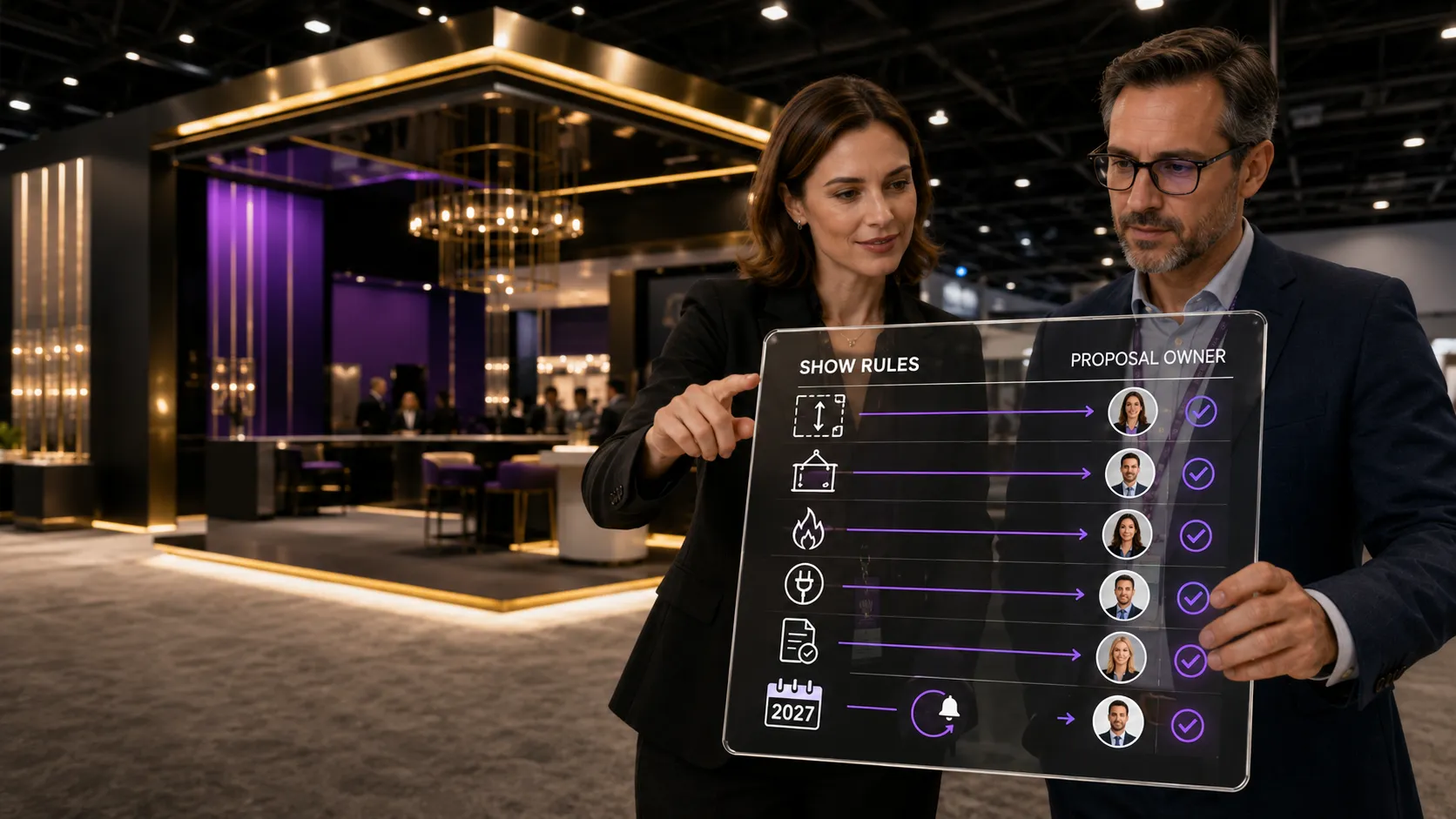
KBIS 2027 Rule-to-Proposal Crosswalk
A show rule matters twice: first when the exhibit is designed, and again when the proposal assigns responsibility for satisfying it.
Current official KBIS guidance identifies several requirements that should appear in every serious builder comparison. The final 2027 Exhibitor Service Kit will continue to develop, so bidders should also name the person responsible for monitoring updates.
The official KBIS exhibitor FAQ and Exhibitor Resource Center are the controlling public references. If the final service kit changes a rule, deadline or provider, update the proposal and this guide—do not preserve an outdated detail merely because it appeared in an earlier draft.
What “Full-Service” Means When Official Providers Perform the Work
One accountable exhibit partner does not mean one company physically performs every venue service. It means one team maintains the responsibility map and makes sure every handoff has an owner.
The current KBIS authorized-provider list identifies Freeman for services including freight, labor, electric, water and drain, compressed air, rigging, cleaning and furnishings, and Cox Communications for internet and telephone.
A full-service KBIS exhibit partner should still:
- Translate the booth design and products into accurate service requirements
- Prepare plans, quantities and order information
- Track deadlines and approval dependencies
- Clarify which charges are included, estimated, billed separately or paid directly
- Coordinate provider timing with booth installation
- Test the completed service in the actual exhibit
- Own the escalation path when a handoff is late, incomplete or inconsistent
The provider may perform the service. The builder should make the responsibility unmistakable.
Before You Send a KBIS Booth Builder RFP, Standardize the Brief
You cannot compare three proposals fairly if each company is quoting a different interpretation of the project.
Start with one written KBIS exhibit brief and send the same information to every shortlisted builder.
Copy-and-Paste KBIS Booth Builder RFP Invitation
Copy this text, replace the bracketed fields and send it with the standardized brief below.
Subject: KBIS 2027 booth proposal request — [Brand] — [booth size]
We are inviting a short list of exhibit companies to propose for our KBIS 2027 booth at the Las Vegas Convention Center. Every company will receive the same brief, product information, working budget assumptions and response deadline. Please separate fixed prices, estimates, allowances, exclusions and client responsibilities; identify who owns every major show-service and delivery task; and include completed-work evidence relevant to our products and booth complexity. We will compare responses using the same evidence-based scorecard and may request a finalist clarification meeting before award. Please confirm your intent to participate by [date] and submit your proposal by [date].
Send the invitation and brief as one controlled package. If a bidder receives a material clarification, send the same answer to every finalist so that no company is scored against information the others never received.
Include:
- Show information: KBIS 2027, booth number, hall, dimensions and booth configuration.
- Business goals: Product launch, dealer meetings, lead generation, media appointments, distributor recruitment, brand awareness or another measurable priority.
- Priority audiences: Designers, builders, architects, dealers, retailers, distributors, media, strategic accounts or international partners.
- Product list: Dimensions, weights, quantities, declared values, installation instructions and expected delivery dates.
- Working-display requirements: Water, drainage, electricity, ventilation, compressed air, internet, sound, lighting controls or other utilities.
- Experience requirements: Demonstrations, presentation areas, sample libraries, hospitality, private meetings, storage and staff work areas.
- Brand assets: Brand standards, campaign message, product photography, video, logos and required graphic content.
- Construction preference: Custom, rental or hybrid—if already decided. If not, ask each builder to recommend the right approach and explain why.
- Future use: Other shows, alternate booth sizes, storage needs and expected lifespan.
- Commercial information: Working budget range, desired approval date, procurement requirements and decision process.
One-Page KBIS 2027 Booth Builder RFP Brief Template
Complete this once, save it as a PDF and send the unchanged version to every shortlisted company.
Do not let a finalist replace a blank field with an assumption hidden inside its proposal. Resolve the field for every bidder or mark it as the same documented assumption for all of them.
When procurement policy permits, share a realistic budget range. It helps the design team decide where custom fabrication creates value, where rental structure makes sense and which ideas will survive the full project cost.
For a detailed view of cost categories and planning ranges, use Purple Exhibits’ KBIS exhibit booth cost guide.
Three terms that should never be bundled into one vague line item Freight moves the exhibit to and from Las Vegas. Drayage moves freight between venue receiving and the booth. Installation and dismantle (I&D) is the labor that builds and removes the exhibit. They are separate costs, scopes and responsibilities.
How to Use the 100-Point KBIS Booth Builder RFP Scorecard
Score every company against the same categories. Do not score the rendering separately from the team and plan required to deliver it.
The downloadable workbook breaks these categories into 32 weighted criteria, supports up to five finalists and automatically applies evidence caps, pass-or-fail gates and cost normalization.
Rate each criterion from zero to five:
- 5 — Complete: Specific, relevant and supported by verifiable evidence
- 4 — Strong: Specific and credible, with only minor gaps
- 3 — Adequate: A credible minimum response that still needs confirmation
- 2 — Partial: Important details or ownership remain unclear
- 1 — Generic: Sales language without a project-specific plan
- 0 — Missing: Contradictory, unacceptable or not addressed
Then cap the rating based on the evidence supplied. Complete documented evidence can receive up to 5; incomplete documentation up to 4; a project-specific verbal answer without documentation up to 2; and a generic, unsupported, missing or contradictory answer receives 0. This prevents a polished presentation from outscoring a documented delivery plan.
For each criterion:
Weighted points = capped rating ÷ 5 × criterion weight
The score is a decision tool, not an automatic answer. A company should not win solely because it earned two more points. Use the scorecard to expose the differences that a rendering and total price can hide.
How Purple Built the Scorecard
The weighting is intentionally delivery-heavy:
- 50 points test relevant proof, engineering, fabrication, installation and dismantle—the disciplines that determine whether an attractive concept can be built and operated as promised.
- 20 points test proposal transparency, commercial terms and change control—the disciplines that reveal hidden scope and surprise-cost exposure.
- 20 points test strategy, project management, reuse and long-term program value.
- 10 points test Las Vegas logistics and official show-service coordination.
The weighting reflects Purple’s professional judgment. It is not an official KBIS, NKBA or Emerald scoring model. Apply the same criteria to Purple and every other bidder.
Suggested Review Bands — Version 1.0
These weights and review bands are procurement aids based on Purple’s professional judgment. They have not been independently validated as predictors of show performance.
In the workbook, scope clarity is the percentage of the same 24 cost-and-responsibility lines with a named owner rather than TBD.
Any failed pass-or-fail requirement overrides the numerical score. A pending gate means hold and clarify, not “close enough.” Engineering, proposal transparency, Las Vegas logistics or I&D below 60% should also be treated as a core-risk warning.
1. How to Compare KBIS Exhibit Companies: Relevant Proof — 15 Points
Begin with completed work.
Ask each builder to show projects that are relevant in at least two ways:
- The same show or a comparable design-and-construction event
- A similar booth size or level of complexity
- Products with similar weight, utility or display requirements
- A similar visitor experience, such as room environments, live demonstrations or dealer meetings
For every example, ask:
- Was it built or only designed by this company?
- Which services did the company manage?
- Who handled engineering, fabrication, freight and installation?
- Did the company provide on-site supervision?
- Can you see real photographs or video from the finished show floor?
- Can the company provide a reference for a comparable project?
A portfolio filled with polished renderings does not prove installation quality. Likewise, photographs without a clear explanation of scope do not prove that the company managed the complete project.
Look for both.
2. Custom KBIS Booth Design: Strategy Before Rendering — 10 Points
The proposal should show that the builder understands why your company is exhibiting.
A strategic KBIS booth design should make the following clear:
- What visitors understand from the aisle
- Which products receive priority
- Why the right attendee enters
- How visitors move through the booth
- Where demonstrations and conversations happen
- How staff identify and qualify opportunities
- What action a visitor should take next
Beware of a proposal that describes every feature but never explains the visitor journey or business purpose.
At KBIS, “beautiful” is the starting expectation. The booth must also help people discover, compare, experience and specify the product.
If you are still defining the layout direction, review Purple Exhibits’ KBIS 2027 booth design ideas by size and product category.
3. Engineering and Product Integration — 15 Points
Engineering is where an attractive concept becomes a working booth.
Ask the builder to explain how the creative design becomes a technical plan. The answer should cover the actual products—not only the booth walls.
Depending on the exhibit, that may include:
- Structural calculations and engineered components
- Load-bearing platforms and reinforced product supports
- Cabinet, appliance, fixture and surface installation details
- Electrical load schedules and floor plans
- Water supply, drainage and waterproofing
- Ventilation and heat management
- Internet, data and device connectivity
- Hanging-sign and rigging coordination
- Accessible service points
- Product cleaning and maintenance
- Test procedures and backup plans
The official KBIS exhibitor FAQ includes show-specific requirements for booth construction, flooring, hanging signs, rigging and Exhibitor Appointed Contractors. A qualified KBIS exhibit contractor should know which questions must be resolved with show management, the venue and official providers before fabrication is locked.
4. Fabrication, Pre-Build and Quality Control — 10 Points
Ask where and how the exhibit will be built.
The proposal should identify:
- Which elements are custom fabricated
- Which elements come from rental inventory
- Where production takes place
- Who controls material purchasing and shop drawings
- What is assembled or tested before shipping
- How graphics, lighting and AV are checked
- How products are received and inspected
- How components are packed, labeled and inventoried
- What happens if something fails quality control
Not every booth needs a complete trial assembly. Every booth does need a quality-control plan appropriate to its complexity.
A multi-room exhibit with working products requires a different level of pre-show testing from a focused 10×20 rental. The builder should be able to explain the difference without pretending that one process fits every project.
5. KBIS Booth Proposal Scope and Price Transparency — 15 Points
“Turnkey” is useful only when the proposal defines what it means.
The strongest KBIS booth proposals separate the project into clear line items and identify every inclusion, exclusion, allowance, estimate and client responsibility.
At minimum, compare:
An unusually low proposal may be efficient. It may also be incomplete.
Do not ask, “Why is this builder more expensive?” until you have also asked, “What is the other builder leaving out?”
How to Normalize KBIS Booth Proposal Costs
A proposal total is not a comparable project cost until every bidder is carrying the same responsibilities.
For each scope line, record who owns it, how it is priced and what amount sits outside the builder’s proposal. Use the same labels across all finalists: fixed included, allowance, estimate, quoted separately, excluded, client-supplied or not addressed.
The workbook calculates:
Normalized project cost = stated proposal price + known outside costs + normalization adjustments
It also counts unresolved and excluded scope lines. That matters because a low number with eight unpriced responsibilities is not more certain than a higher, complete proposal. It is less finished.
Worked Example: The Lower Bid Is Not Always the Lower Cost
The following numbers are illustrative—not KBIS pricing and not a Purple Exhibits quotation.
Proposal A appears $15,000 lower at first glance. After both bidders are assigned the same responsibilities, Proposal B is $3,000 lower and carries fewer unpriced handoffs.
The point is not that a higher bid is automatically better. The point is that price becomes meaningful only after scope is comparable.
Already comparing proposals? Send Purple the same brief, renderings and scope tables provided to your finalists. We can identify what is fixed, estimated, excluded or still unowned, then build a proposal around the complete project. Ask Purple for a KBIS 2027 proposal
6. KBIS Las Vegas Logistics and Official Show Services — 10 Points
A builder does not need a Las Vegas mailing address to execute successfully at the Las Vegas Convention Center. It does need a credible Las Vegas plan, qualified crews and accountable show-site leadership.
Purple’s Las Vegas trade show booth services cover local installation, logistics and venue coordination as part of a complete project scope.
Ask how the company will manage:
- The current KBIS Exhibitor Service Kit and deadlines
- Booth-specific target move-in information
- Exhibitor Appointed Contractor notification, insurance and venue requirements
- Freight routing and marshaling-yard procedures
- Advance-warehouse versus direct-to-show delivery
- Drayage and empty-container handling
- Electrical, plumbing, internet and rigging orders
- Crew scheduling and overtime exposure
- Clean-floor requirements and final inspection
- Dismantle, outbound shipping and forced-freight risk
The public KBIS Exhibitor Resource Center is updated as show information becomes available. Your proposal should state who monitors those updates and who submits each required form or order.
Local knowledge is valuable. Written ownership is more valuable.
7. Installation, On-Site Supervision and Dismantle — 10 Points
Installation and dismantle are not small line items at the end of the proposal. They are the moment when every design, engineering, production and logistics decision meets reality.
Ask for:
- A preliminary installation sequence
- Expected crew size and working hours
- A named on-site supervisor
- Coordination responsibilities between booth labor and official service providers
- A product-placement and testing plan
- A client walkthrough before opening
- A punch-list and correction process
- Show-day technical or repair coverage
- A dismantle and repacking sequence
- An outbound-shipping and storage handoff
For a complex KBIS exhibit, the on-site supervisor should understand the design intent, product requirements and proposal scope. A person seeing the project for the first time during move-in cannot provide the same level of control.
8. Project Management and Communication — 5 Points
Ask who will manage the work after the contract is signed.
The answer should include:
- One accountable project lead
- A defined communication rhythm
- A written schedule with approvals and dependencies
- A process for recording decisions
- Clear response expectations
- Named owners for client-supplied products, graphics and content
- An escalation path for urgent issues
The handoff from sales to production matters. Clarify whether the person who understands the proposal remains involved or whether the project moves to a new team.
Purple believes exhibitors should know exactly who owns the project and what happens next. The work may be complicated. The communication should not be.
9. Reuse, Storage and Long-Term Value — 5 Points
If KBIS is one event in a larger program, evaluate the booth beyond February 4.
Ask:
- Which components can be reused?
- Can the exhibit adapt to different footprints?
- Who owns each structure, graphic, light, AV item and piece of furniture?
- What requires refurbishment after the show?
- Where will the booth and products be stored?
- How is inventory documented?
- What will it cost to use the exhibit again?
A lower first-show cost can become a higher program cost if the exhibit is difficult to resize, expensive to ship or impossible to repair.
The right answer may be custom, rental or hybrid. The builder should explain the recommendation using your show calendar and goals—not its inventory needs.
10. Commercial Terms and Change Control — 5 Points
Before selecting a KBIS booth construction company, read the commercial terms as closely as the design proposal.
Confirm:
- Payment schedule
- Approval deadlines
- Revision limits
- Change-order process
- Cancellation terms
- Client-delay consequences
- Ownership of design and fabricated assets
- Rental-damage responsibility
- Storage and disposal terms
- Warranty or correction obligations
- Estimates that may change after official show orders are placed
Ask for the assumptions behind every allowance.
The goal is not to eliminate every possible change. It is to prevent normal project decisions from becoming surprise invoices.
Apply These Pass-or-Fail Requirements Before Scoring Price
Some issues should not be averaged into a 100-point score.
Treat the following as pass-or-fail requirements:
- The company can provide real completed-work evidence
- The proposed design can be engineered and approved
- Product weights, utilities and installation responsibilities are addressed
- The proposal identifies what is included and excluded
- A realistic schedule exists
- The company can satisfy current EAC, insurance and venue requirements when applicable
- A named project manager and show-site escalation contact are assigned
- The builder explains who owns freight, installation, dismantle and outbound shipping
If one of these requirements is unresolved, pause the decision. Do not let a strong rendering compensate for a material delivery risk.
Questions to Ask Every KBIS Booth Builder During Finalist Meetings
Use the same questions with every finalist:
- Show us three completed projects that are closest to our KBIS booth and explain your exact scope on each.
- What is the most difficult part of our current brief?
- Which product details must be finalized before engineering, and who receives, installs, tests and repacks the products?
- Which elements are custom, rental or client-supplied, and what will be pre-built before shipping?
- Which show services will you coordinate, order and test, and which will we pay directly?
- What freight, material-handling and labor assumptions are in the price?
- Who owns the schedule, installation supervision and show-site escalation path?
- What is the most likely change-order trigger, and which client deadlines affect it?
- What happens if a product, graphic or booth component arrives late or damaged?
- How will the exhibit be dismantled, inventoried, stored and adapted for our next show?
- What is not included that exhibitors often assume is included?
That final question often exposes the largest difference between a low proposal and a complete one.
KBIS Booth Proposal Red Flags That Should Stop the Process
Be cautious when you see:
- A striking rendering with little production detail
- “All-inclusive” pricing without itemized scope or a distinction between allowances and fixed prices
- Portfolio images with no explanation of the builder’s role
- No product-receiving, utility or installation plan
- No named project manager, on-site supervisor or escalation contact
- A schedule that begins only after final design approval
- Freight and material handling treated as interchangeable terms, or no outbound-freight plan
- Heavy reliance on “TBD” after the contract value is fixed
- Pressure to sign before important scope questions are answered
Not every unknown is a problem. KBIS forms and official rates continue to develop as the show approaches.
The problem is an unknown with no owner, process or allowance.
Frequently Asked Questions About Choosing a KBIS Booth Builder
What should be included in a KBIS booth builder RFP?
Include the show, venue, booth number, dimensions, configuration, objectives, audiences, product list, product dimensions and weights, utility needs, desired experiences, brand assets, budget range, schedule, future-use needs and required proposal format. Every bidder should receive the same information.
How many KBIS exhibit companies should we compare?
For most projects, three qualified finalists provide enough comparison without creating an unnecessarily long design and procurement process. Prequalify them before requesting full concepts by reviewing completed work, relevant experience, capabilities and availability.
What proof should a KBIS booth builder provide?
Request finished show-floor photographs, a written explanation of the builder’s exact role, project details comparable to your size and product complexity, references, engineering or production examples, a pre-build and quality-control plan, named delivery leaders and evidence for every important proposal assumption. Renderings alone prove design intent—not delivery.
Do we need a local Las Vegas exhibit builder for KBIS?
Not necessarily. You need a company with a credible Las Vegas execution plan, qualified labor, current show knowledge, EAC and insurance readiness, reliable freight coordination and experienced on-site supervision. A local facility can be helpful, but an address alone does not prove project control.
When should we choose our KBIS 2027 booth builder?
Large custom exhibits should ideally begin many months before the show so there is time for strategy, design, revisions, engineering, fabrication, product coordination, testing, shipping and service orders. Smaller rental projects may require less time. Starting early creates more options and reduces avoidable rush costs.
Should we request a custom, rental or hybrid KBIS exhibit?
Ask builders to recommend the right approach based on your goals, booth size, product requirements, budget and future show calendar. If you are comparing a custom build with a KBIS booth rental, require both options to identify graphics, flooring, lighting, freight, I&D, return requirements and ownership.
A rental can provide flexibility, a custom exhibit can provide greater architectural control and a hybrid can concentrate custom investment on the features visitors notice most.
Can a KBIS booth builder coordinate working plumbing and appliances?
Yes, when the requirements are identified early and comply with current show and venue rules. The plan may involve water, drainage, waterproofing, electrical power, ventilation, internet, cleaning, testing and technical support. The proposal should state who owns each task.
Does a KBIS exhibit builder handle electrical, plumbing, rigging and internet orders?
Many full-service builders coordinate these orders, but exclusive providers may perform the work and bill the exhibitor directly. Confirm exactly which forms, orders, estimates and payments the builder manages.
What is an Exhibitor Appointed Contractor at KBIS?
An Exhibitor Appointed Contractor, or EAC, is a contractor hired by the exhibitor rather than the show’s general contractor for eligible services. Current KBIS rules require applicable notification, insurance and compliance documentation. Verify the latest requirements through the official Exhibitor Resource Center.
What is the difference between a KBIS booth builder and an official KBIS service provider?
A booth builder designs, produces and manages the exhibit scope defined in its contract. Official or authorized show providers perform designated venue services such as freight handling, labor, utilities, rigging, cleaning or internet.
A full-service exhibit partner may coordinate those providers, but the proposal must state who orders, performs, approves, tests and pays for each service.
Is the “KBS Show” the same as KBIS?
Searchers sometimes type “KBS Show,” but the official acronym is KBIS, for the Kitchen & Bath Industry Show. Use KBIS in contracts, service orders and exhibitor forms.
How should we compare two KBIS booth proposals with different prices?
Normalize the scope first. Compare design, engineering, structure, graphics, product integration, AV, flooring, furniture, freight, drayage assumptions, show services, I&D, supervision, dismantle and storage line by line. Then compare price, risk and long-term value.
How much does a KBIS exhibit booth cost?
The total varies widely by size, design complexity, construction method, product displays, technology, utilities, freight, drayage, labor and on-site support.
Review Purple Exhibits’ 2027 KBIS booth cost and builder guide for detailed planning ranges and cost categories.
May our team use or cite this KBIS scorecard?
Yes. Exhibitors may use the workbook internally with any builder. Editors, associations and industry educators may cite the framework and link naturally to the canonical article. Contact Purple before republishing the complete tool or creating a co-branded edition.
Ready to score the proposals? Download the Free KBIS RFP Scorecard (PDF) Eight pages · 32 weighted criteria · eight gates · 24 scope-ownership lines
Ready to Compare Your KBIS Booth Options?
Send what you have. A finished RFP is not required. Start with your booth size, product list, goals, working budget and target decision date.
Purple will help identify the right exhibit approach, define missing scope and build a proposal around the complete project—not only the rendering.
Start your KBIS 2027 proposal or see the Fabuwood exhibit named Best Large Booth at KBIS 2026.
Your next show already has a deadline.
Your booth should have one accountable team.
JUST SHOW UP. We’ll handle the rest.
Purple Exhibits is an exhibit design, production and project-management company. It is not affiliated with, sponsored by or endorsed by KBIS, NKBA or Emerald.