

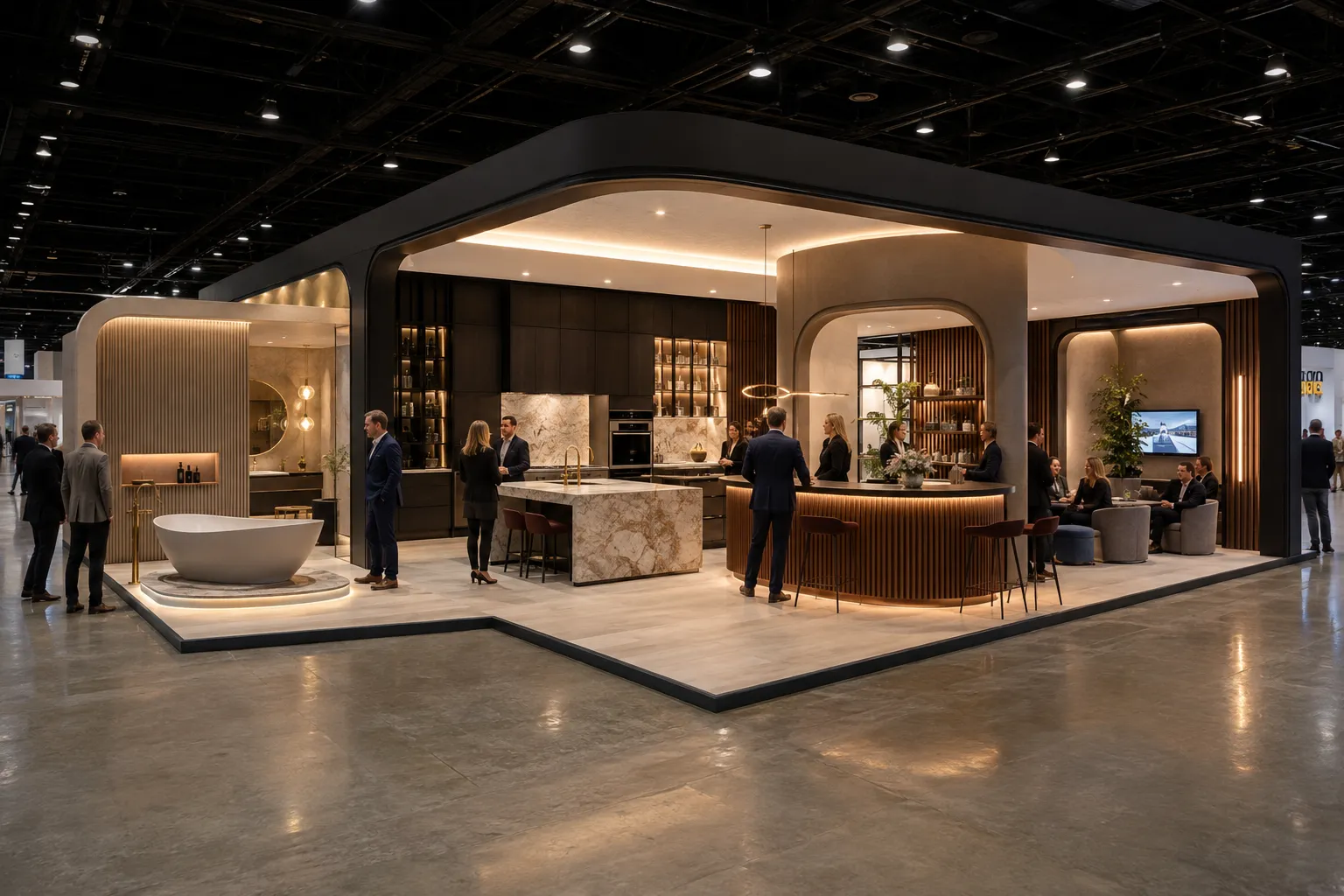
KBIS 2027 · February 2–4 · Las Vegas Convention Center
Designed for the aisle. Engineered for the product. Ready for opening day.
At KBIS, your booth is more than a display. It is a working showroom where buyers open drawers, compare finishes, test hardware and judge how products perform. A strong KBIS booth rental has to look unmistakably yours—and handle the product, utility and installation details behind the experience.
Purple Exhibits plans custom-looking KBIS booth rentals in Las Vegas around the products visitors need to see, touch and understand. Depending on the written scope, Purple can connect exhibit design, reusable structure, custom branding, product integration, graphics, audiovisual systems (AV), freight coordination, installation, dismantling and on-site support.
Bring us the product. We’ll map the booth around it.
**START MY KBIS 2027 BOOTH PLAN**
No finished RFP required. “Not sure” is a valid answer.
Documented Purple KBIS Execution
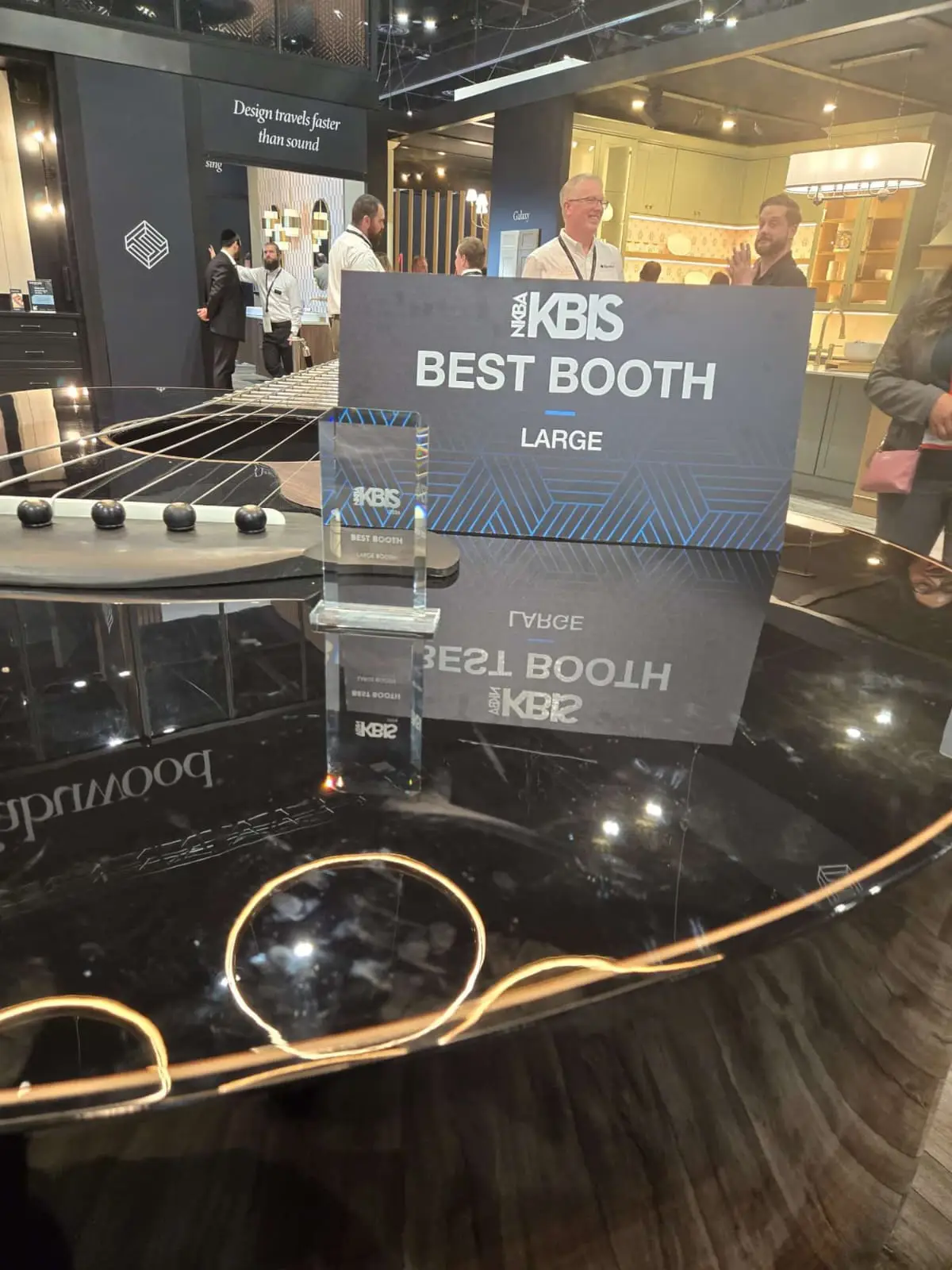
At KBIS 2026, Purple’s published case study documents its role in project management, fabrication, logistics, installation and on-site support for Fabuwood’s multi-room cabinetry exhibit. KBIS independently named Fabuwood the 2026 Best Large Booth winner.
The award belongs to Fabuwood, and the project is not presented here as a rental. It is cited as documented evidence of Purple’s role on a complex KBIS exhibit.
What Should a KBIS Booth Rental Company Actually Handle?
A KBIS booth rental company should do more than rent walls. It should turn the floor space, product list, brand goals and show requirements into an opening-ready plan. Before approving a provider, require five dated, project-specific outputs:
- Product-fit plan: Dimensions, weights, utilities, attachment and service access.
- Labeled scope: What is rented, owned, custom-built, client-supplied, directly ordered and excluded.
- Responsibility matrix: One owner, deadline, required input, proof and fallback for every dependency.
- Opening-ready checklist: Installation, products, graphics, AV, utilities, cleaning and testing.
- Post-show plan: Rental returns, owned assets, products, damage, storage and reuse.
A rendering and structural price alone do not establish execution readiness.
Purple can combine reusable structure with custom fabrication, graphics, AV, product integration, freight coordination, installation and on-site supervision. Some services—including rigging, electrical, plumbing, internet and material handling—may be performed or invoiced by KBIS- or venue-designated providers. The proposal should show who coordinates, performs and pays for each item.
Is a Purple-Led Rental or Hybrid Program a Fit?
A rental or hybrid program is a strong fit when you want a custom-looking exhibit without owning the full structure, when working products need to be integrated, or when client-supplied products and show services need one coordinated plan.
If product dimensions, utility needs or internal approvals are still unclear, begin with a requirements review before asking for a finished booth price.
Rental is an ownership model—not a visual style. Explore Purple’s trade show booth rental services.
This guide focuses specifically on choosing, scoping and executing a rental or hybrid exhibit for KBIS 2027 in Las Vegas. For broader design-and-build selection, use Purple’s KBIS exhibit booth builder guide; for budgeting, use the KBIS exhibit booth cost guide; for layouts, use the KBIS booth design ideas guide; and for production milestones, use the KBIS 2027 booth planning checklist.
Start Your KBIS 2027 Booth Plan
Tell Purple what you know. Mark the rest “not sure.”
Your footprint, priority products, target budget and approval date are enough to begin a useful conversation. Upload a floor plan, product schedule or RFP if one already exists.
What happens next: A Purple exhibit specialist will review the products, footprint, timing and open decisions, then contact you about the appropriate next step.
KBIS 2027 at a Glance
KBIS brings together designers, architects, builders, remodelers, dealers, fabricators, distributors and other kitchen-and-bath professionals. Because it is co-located with IBS, a visitor can encounter many competing product stories in one journey. The booth has to earn the stop quickly, make evaluation easy and remain presentation-ready through three days of repeated use.
What Is a KBIS Booth Rental?
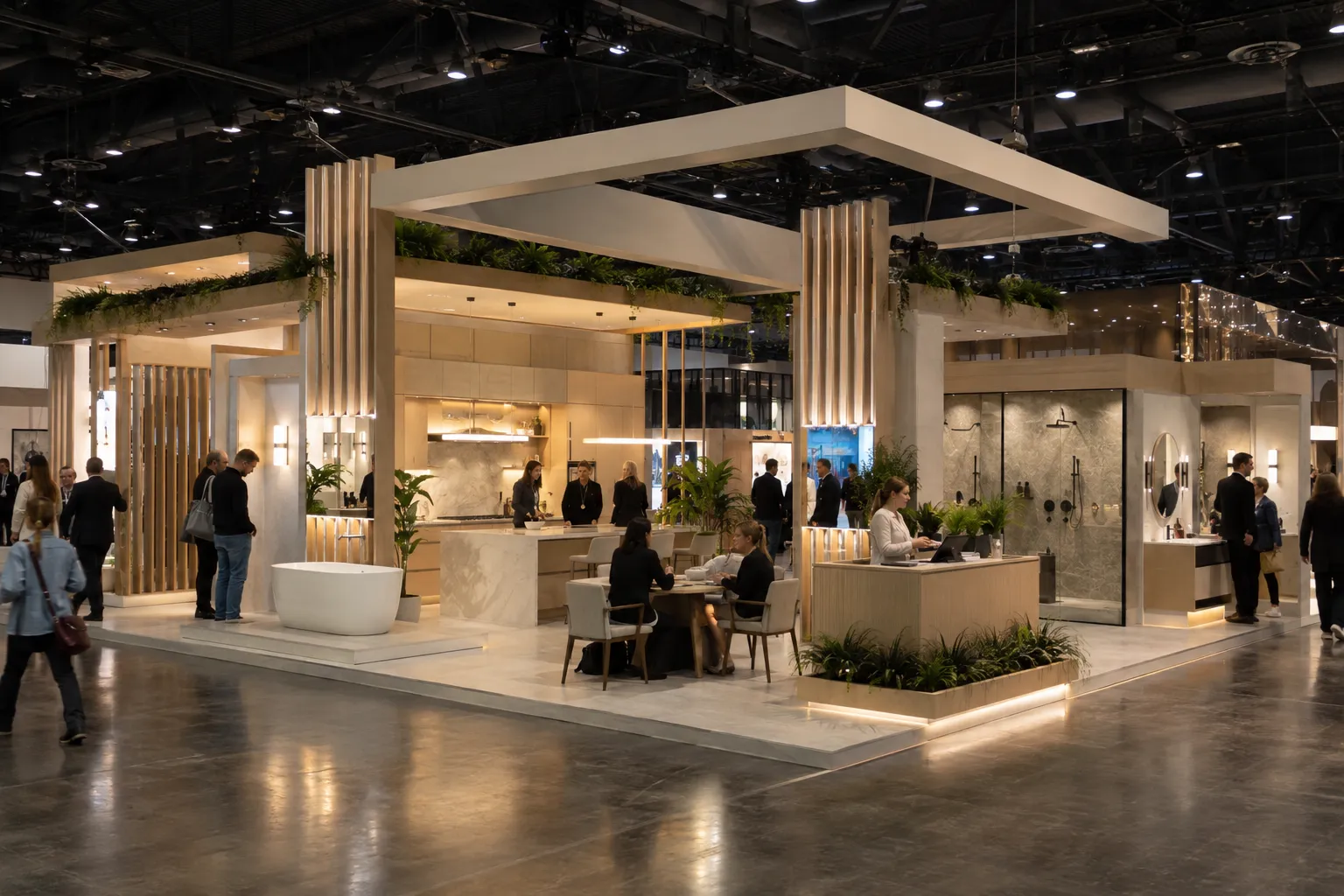
A KBIS trade show booth rental combines leased, reusable structural components with project-specific graphics, product displays, lighting, flooring, furniture, audiovisual systems and agreed services. The exhibitor does not own every structural component, but the completed environment can still look custom and support a product-intensive visitor experience.
Rental describes ownership of the reusable core—not the quality or originality of the visitor experience. A custom KBIS booth rental is not a contradiction.
The reusable core controls ownership and storage. The brand and product layers determine how the exhibit looks, works and feels.
Rental should describe the structure—not the experience.
Pretty is good. Ready is better.
Rental, Hybrid or Custom: Which KBIS Exhibit Is Right for You?
Short answer: Choose rental when flexibility and reduced structural ownership matter most. Choose hybrid when reusable structure can support the booth but high-visibility architecture or product displays need custom fabrication. Choose custom when proprietary architecture, substantial engineering or a stable multi-show program justifies ownership.
Do not choose from appearance alone. Confirm product dimensions, weights, utilities, attachment requirements, show rules and future use first. Use Purple’s KBIS exhibit booth cost guide for detailed budget considerations and the KBIS booth design ideas guide for layouts and visitor flow.
Purple’s Five-Test KBIS Rental Readiness Checklist
Purple’s Five-Test Rental Readiness framework asks five practical questions before production:
- Product fit: Are product dimensions, weights, attachments, clearances, utilities and service access documented?
- Aisle read: Can the right visitor identify the brand, product category and reason to enter from the aisle?
- Touch: Can doors, drawers, controls, samples and working products withstand repeated use and a daily reset?
- Responsibility: Does every input, order, connection, test and approval have one owner, due date and backup?
- Next show: Does every rented, owned and client-supplied item have a post-show destination and reuse plan?
Score each test from 0 — Unresolved to 1 — In progress or 2 — Confirmed. A confirmed test needs a current document, a named owner and a due date. Any zero stops release, regardless of the total score.
The 15 Evidence Criteria
- PF-1 — Product requirements: Dimensions, weight, attachment and handling points, service clearances and access.
- PF-2 — Utilities: Power, water, drainage, ventilation, data and rigging by demand, location, provider, test and fallback.
- PF-3 — Product integration: Supports, cutouts, tolerances, containment, controls and install sequence in buildable drawings.
- AR-1 — Aisle identification: Brand, category and reason to enter are clear from the intended approach.
- AR-2 — Sightline performance: Message and product hierarchy work from realistic viewing distances.
- AR-3 — Occupied circulation: Entrances, demonstrations, meetings and flow remain clear with people in the space.
- TT-1 — Repeated interaction: Doors, drawers, controls, samples and working products tolerate repeated use.
- TT-2 — Daily reset: Cleaning, charging, consumables, spares and after-hours access have a procedure and owner.
- TT-3 — Repairability: High-touch finishes, hardware and graphics can be repaired without disabling the exhibit.
- RT-1 — Accountability: Every product, graphic, shipment, order, connection, test and approval has one owner.
- RT-2 — Dependencies: Each dependency has a due date, required input, proof and fallback.
- RT-3 — Commercial scope: Included, estimated, allowed, direct-order, client-supplied and excluded items are labeled.
- NS-1 — Disposition: Every rented, owned and client-supplied item has a post-show destination.
- NS-2 — Reuse feasibility: Next footprint, graphic change, packing, repair and storage are realistic.
- NS-3 — Closeout: Inventory, damage, missing items, final costs and next-use decisions have owners and dates.
Read Your Score
Five-Test Rental Readiness Methodology and Evidence Map
Apply the Five-Test framework to one named booth concept using the current product, service and post-show plans. It is a practical pre-production check—not KBIS approval, an engineering review or a prediction of leads, sales or ROI.
USE THE FREE INTERACTIVE READINESS SCORER
Download the complete 15-criterion evidence map or the fillable KBIS 2027 Booth Rental Readiness Checklist.
The methodology and evidence map may be reused under CC BY 4.0 with attribution to Purple Exhibits. The branded checklist artwork remains under CC BY-ND 4.0.
A verbal statement that an item is “handled” is not evidence. A confirmed item needs a current document, a named owner and proof it is done.
Recheck requirements through the KBIS Exhibitor Resource Center, KBIS FAQ and current floor plan and exhibitor list. Those sources govern applicable show requirements; they do not issue, sponsor or endorse Purple’s framework.
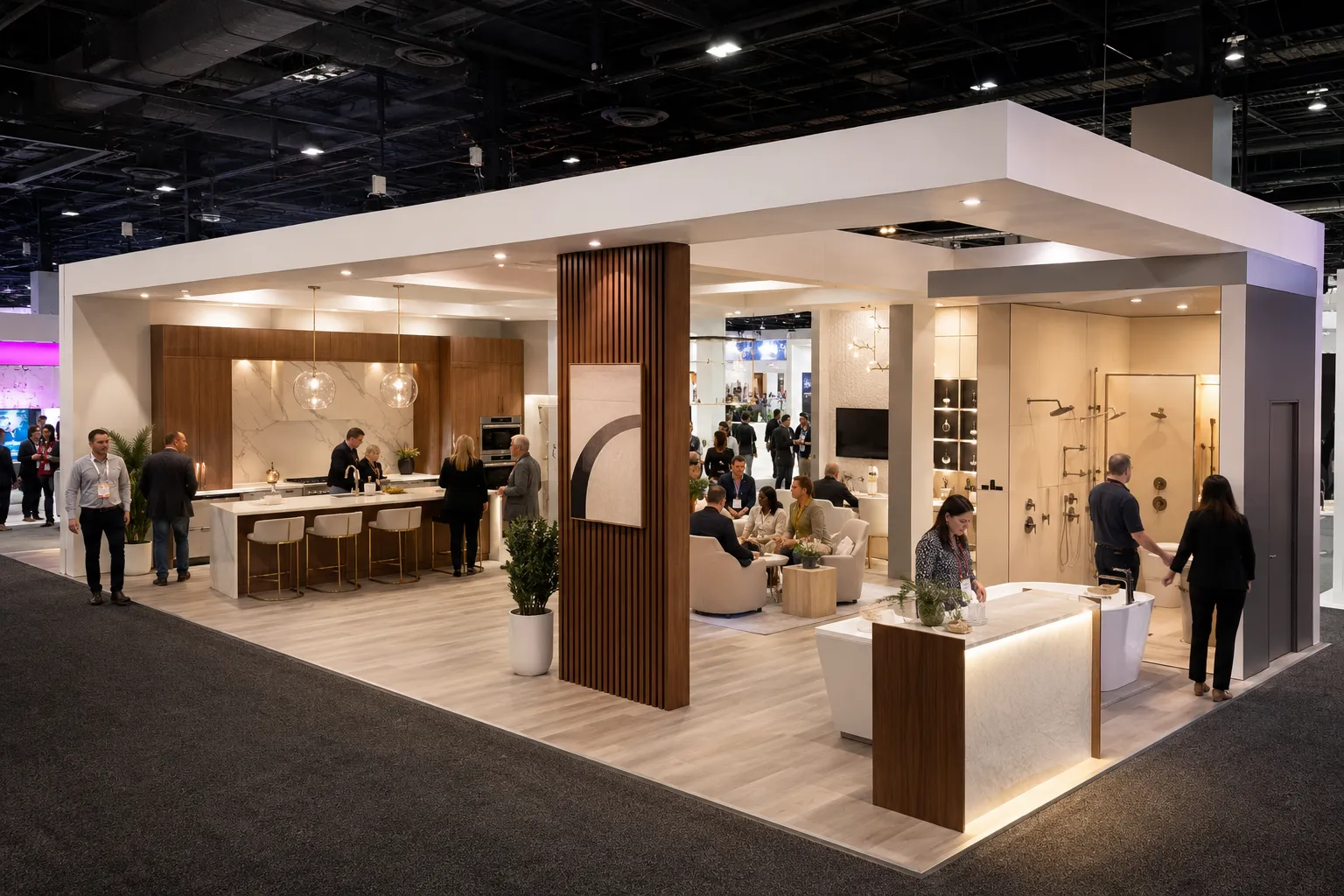
Choose a KBIS Rental Strategy by Booth Footprint
A well-planned KBIS exhibit rental follows the floor space, product story and visitor behavior. These are planning patterns—not catalog packages or fixed inclusions.
Use the footprint to organize the experience, not to limit the brand. The final design must follow the confirmed booth configuration, assigned location and current KBIS rules.
Explore Purple’s 10×10 rental exhibits, 10×30 rentals and broader trade show booth rental services.
What Makes a KBIS Booth Rental Different?
A general trade show rental can look polished and still be wrong for KBIS. Kitchen-and-bath products introduce clearances, weight, utilities, repeated handling, finish protection and demonstration requirements that must be resolved before the rental structure is finalized.
Purple’s guide to working-product and utility planning for KBIS covers working-product, utility and engineering requirements in greater depth.
Resolve the products before shipment.
How Should a KBIS Booth Present Colors, Textures and Finishes?
At KBIS, the exhibit is a temporary showroom. A flat graphic cannot do all the work of a physical finish.
- Put priority samples where visitors can see them under the specified exhibit lighting and touch them without blocking the aisle.
- Group related colors or materials and label collections so a conversation can move from visual interest to a specific product.
- Check every priority finish under the proposed lamp type and color temperature; screen and print color are not substitutes for a physical approval.
- Give doors, drawers, handles and sample systems enough clearance for repeated use.
- Define cleaning products, replacement samples, repair options and the daily reset owner before opening.
- Protect delicate surfaces during freight, installation and storage.
The goal is not to display every option. It is to help the right visitor understand the range, experience the priority products and know what to ask next.
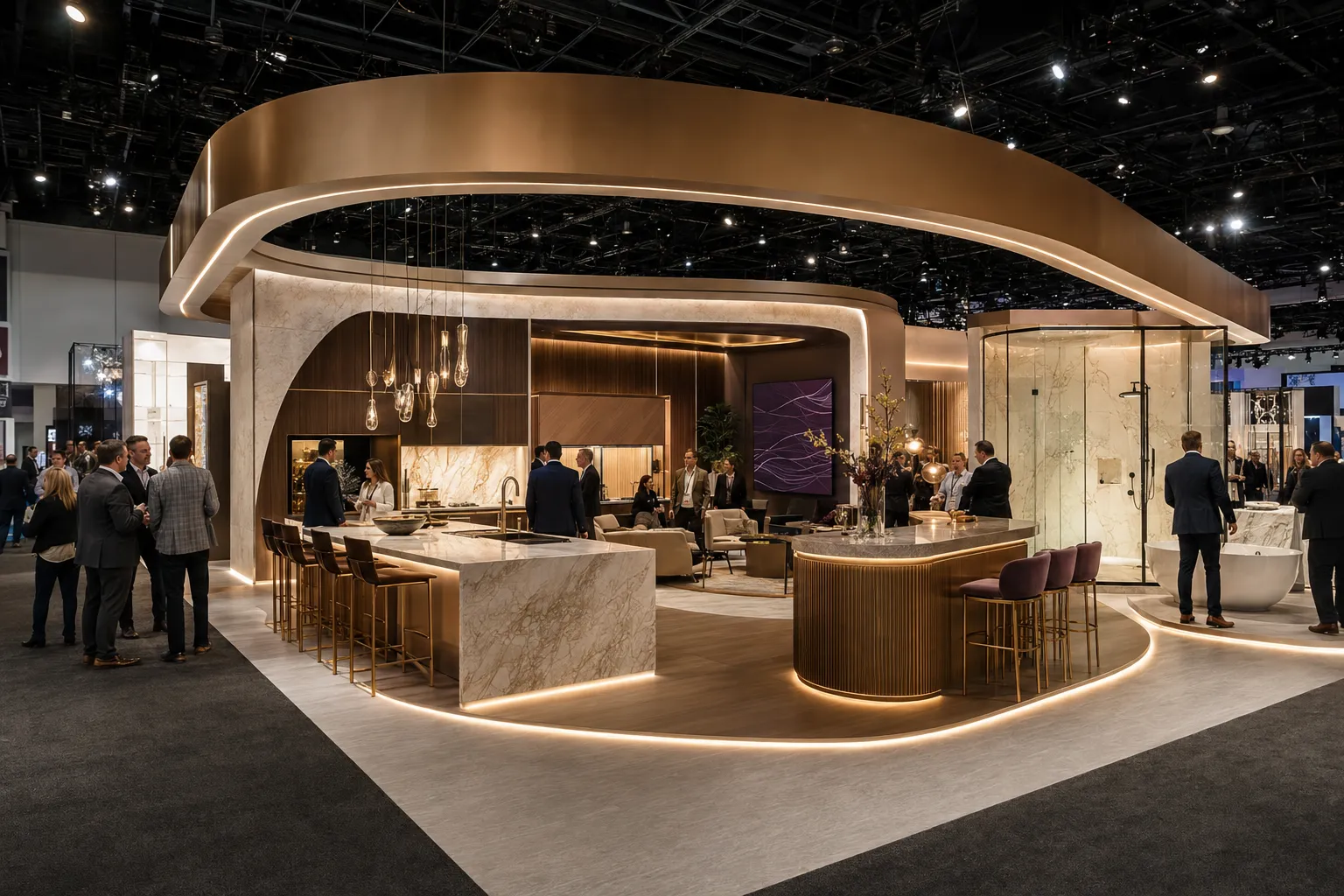
What Can a Turnkey KBIS Booth Rental Include?
A turnkey program can span design, production, Las Vegas execution and post-show closeout. The written proposal—not the word “turnkey”—determines what Purple actually owns.
Six Labels Every KBIS Rental Proposal Should Use
Require every meaningful line item to carry one of these labels:
A fixed price is useful only when the scope is fixed. If freight weight, working-product demands, utility locations, labor hours or client-supplied items are still unknown, the assumptions and change process matter as much as the number.
For a deeper procurement review, use Purple’s 100-point KBIS booth builder RFP scorecard.
One Owner for Every Task
Purple calls this the No-Orphan-Task rule: “turnkey” should mean one accountable plan. It does not mean one company is permitted to perform every service in the Las Vegas Convention Center.
For every major task covered by the agreed project plan, the responsibility matrix should identify:
- Owner: The person or organization accountable for the result.
- Due date: When the result must be ready, not merely requested.
- Required input: The drawing, product, decision, payment or access needed to proceed.
- Completion check: The evidence that proves the task is closed.
- Fallback: What happens if the primary plan fails or arrives late.
“The show has it” is not an owner. “The builder knows” is not a deadline.
Some services may be limited to providers designated by KBIS or the venue. Within the written scope, Purple can plan locations, prepare order information, coordinate timing and supervise the result; the designated provider may perform and invoice the work. The responsibility matrix should make that boundary visible before orders are due.
The visitor should experience simplicity. The project team should be able to see the complexity.
Download the Free KBIS No-Orphan Task Matrix
A booth proposal can look complete while critical work still has no owner. Purple’s free workbook turns the scope into a working accountability plan across design, products, graphics, show services, freight, installation, opening readiness and post-show closeout.
DOWNLOAD THE FREE KBIS 2027 NO-ORPHAN TASK MATRIX
Use the workbook after potential partners are shortlisted. It complements—but does not replace—Purple’s 100-point RFP scorecard: the scorecard supports vendor selection; this matrix supports execution after responsibilities are agreed.
The workbook is an independent planning tool, not an official KBIS form, engineering review or legal agreement. It may be reused under CC BY 4.0 with attribution to Purple Exhibits.
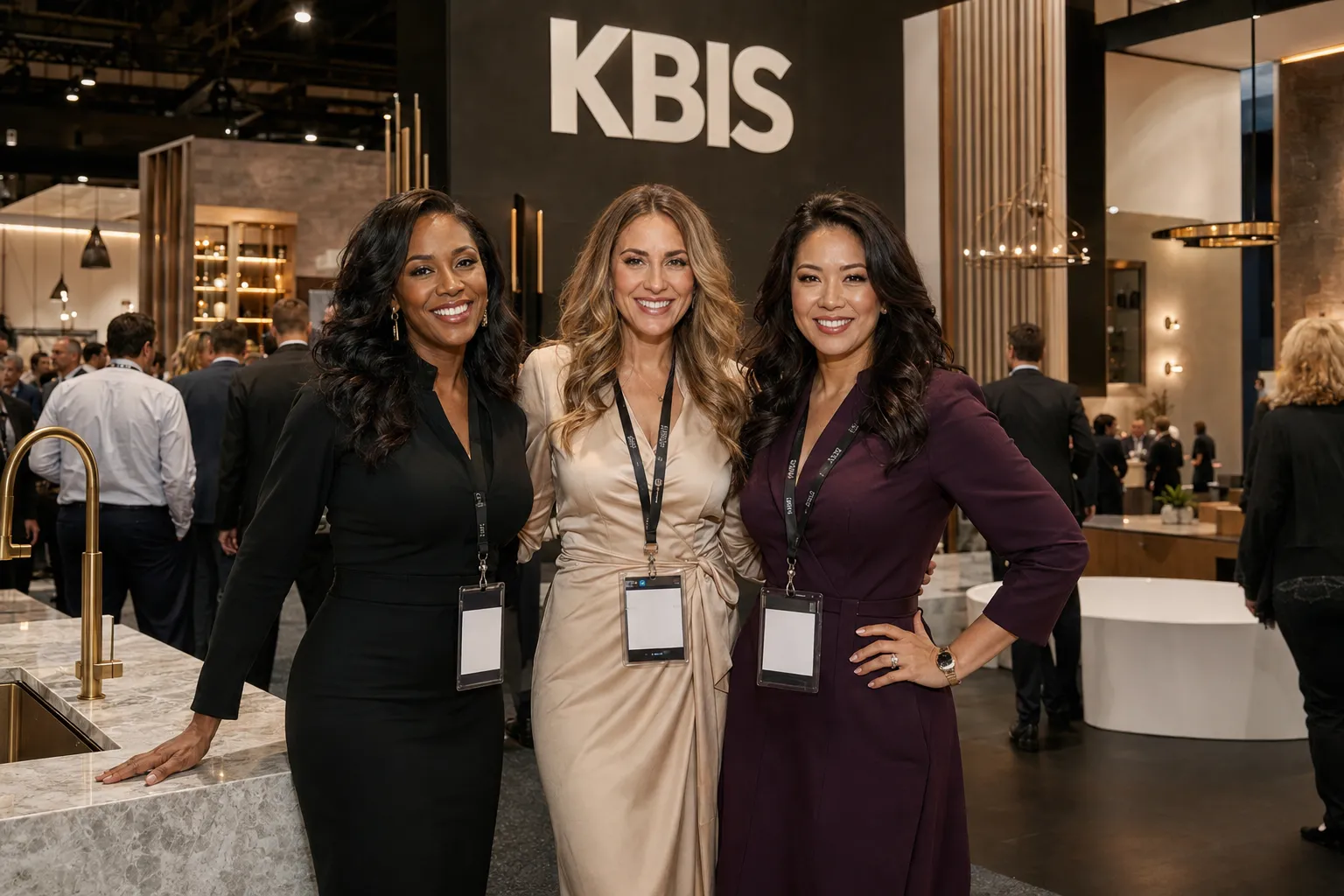
Current KBIS 2027 Planning Facts That Affect a Rental Booth
The official KBIS Exhibitor Resource Center is the controlling source for current forms, floor plans, providers, deadlines and booth-specific information. These facts were last verified August 31, 2026.
What Does KBIS Provide with Exhibit Space?
The official KBIS FAQ describes the standard booth-space package this way. Confirm the assigned booth type and current Exhibitor Services Kit before relying on any item.
Exhibit space is not a booth-rental package. Structure, branding, products, furnishings, utilities, freight, labor and other services must be scoped separately.
- Targeted freight: Every exhibitor has a targeted freight move-in date. The rental shipment plan must use the color-coded schedule for the assigned hall and booth—not a universal arrival assumption.
- Flooring: The official KBIS FAQ states that KBIS is a “No Concrete Show,” so flooring must cover the purchased booth space and belong in the design and cost scope.
- Clean floor: The current FAQ says empty crates and skids must be labeled and removed by 3:00 p.m. Monday, February 1, 2027, and exhibits must be fully installed by 5:00 p.m. that day. The opening-ready plan needs to finish before those cutoffs, not at them.
- Hanging signs: The published standard rule permits hanging signs for island, split-island and peninsula booths of at least 400 square feet. Linear and end-cap booths do not qualify. A noncompliant design requires written variance approval; never assume a variance will be granted.
- Aerial rigging: The current FAQ identifies Freeman as the exclusive aerial-rigging provider for KBIS. Confirm the final order process, dates and prices in the current Exhibitor Services Kit.
- Exhibitor Appointed Contractors: An exhibitor using an EAC must submit the applicable EAC notification and insurance information. The FAQ warns that setup can be delayed until an acceptable certificate is provided.
- Show services: The current Exhibitor Services Kit governs approved providers and detailed orders. Do not carry forward an old year’s forms, rates, badge quantities or deadlines.
- Dismantle: Exhibitors may not begin dismantling before the show closes at 5:00 p.m. Thursday, February 4, 2027.
Check the official resources before design release, before service-order deadlines and again before shipment. Rules, providers, detailed schedules and rates can change.
Four Approvals That Keep a KBIS Rental on Track
A strong project moves through approvals, not assumptions.
Opening-ready means the booth is clean; graphics and products are correctly installed; working displays, utilities, controls and AV are tested with final content; daily reset supplies and access are resolved; and every remaining punch item has one owner and a dated closure plan.
“Construction complete” is not the same as “ready for visitors.”
For a larger milestone schedule, use Purple’s KBIS 2027 booth planning checklist.
What Evidence Should a KBIS Booth Rental Proposal Include?
A KBIS booth rental proposal should turn the five required outputs above into project-specific evidence—not merely repeat a rendering, structural price and capability list.
One proof point deserves special attention: the pre-shipment validation plan. It should state what will be assembled, test-fitted, photographed and checked for electrical, AV and product fit before shipment; what can only be tested at the venue; who receives the evidence; and who closes each exception.
A rendering proves a direction. A dated validation record proves the team has begun resolving how that direction will open at KBIS.
For broader procurement, use Purple’s 100-point KBIS booth builder RFP scorecard.
**START MY KBIS 2027 BOOTH PLAN**
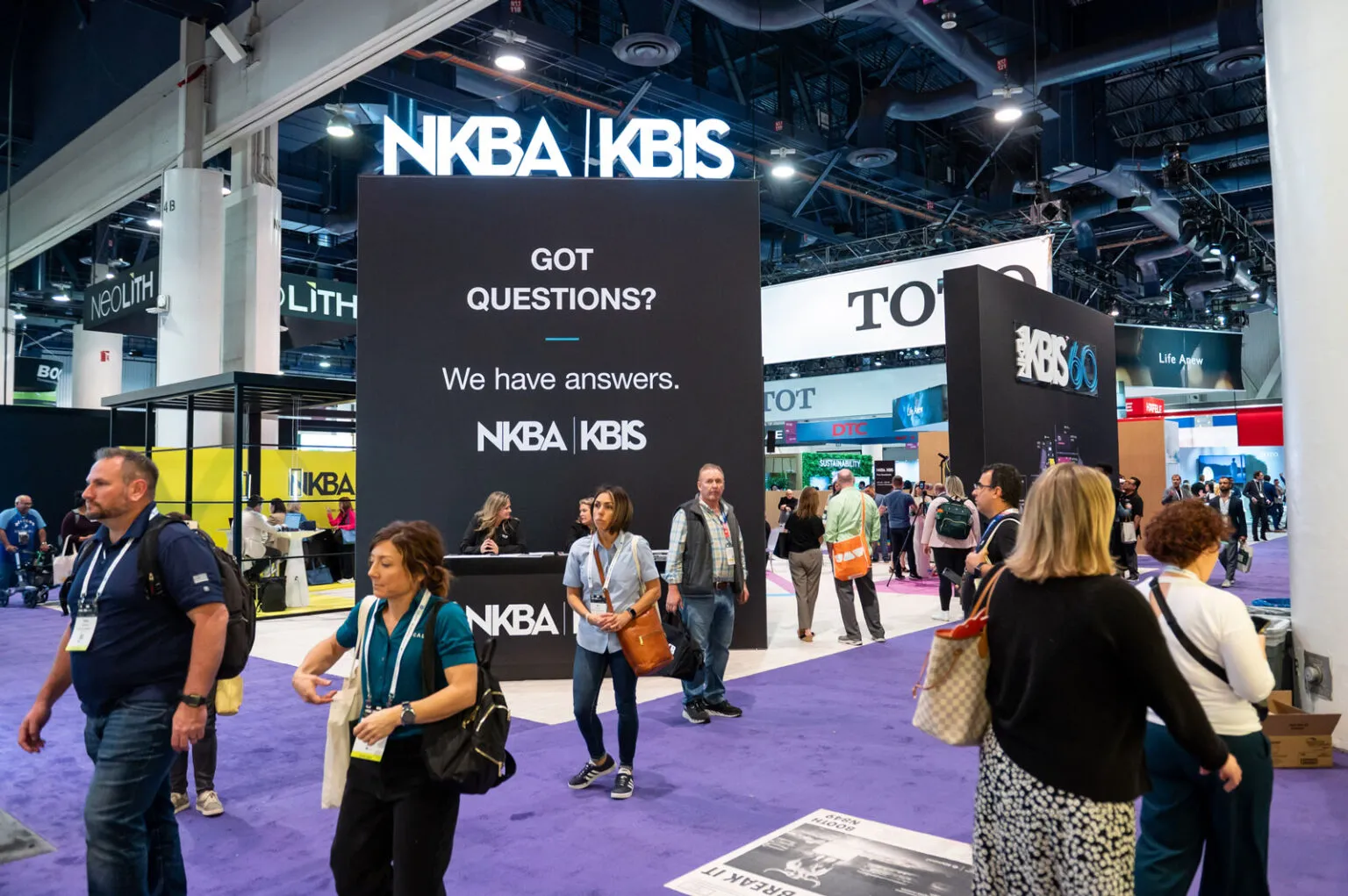
KBIS Rental Planning for First-Time and International Exhibitors
First-time and international exhibitors often have the same underlying risk: too many assumptions live between the product team, exhibit team, freight providers and on-site decision-makers.
The official KBIS international exhibitor page provides current show contacts and Global Connect information. Purple’s exhibit plan should complement—not replace—show management, qualified freight-forwarder, customs-broker, tax, immigration, legal or product-compliance advice.
Close these items early:
- Units and drawings: Put critical dimensions and weights in the units required by each production, freight and service provider. Mark conversions clearly and keep one current, version-controlled product schedule.
- Power and connectivity: Confirm North American voltage, frequency, plug, amperage, heat, data and offline-content requirements for every active product. A travel adapter is not an engineering plan.
- Product shipment versus booth freight: Identify who is importer of record where applicable, who prepares customs documents, what is temporary or permanent, and whether products return, re-export, remain in the U.S. or are disposed of after the show. Use qualified international-logistics and customs professionals.
- Show orders and EAC paperwork: Assign one owner for service-kit orders, EAC notifications, certificates of insurance, approvals and proof of submission.
- On-site authority: Name the person who can approve a field change, replacement, service charge or product decision during installation, including how that person will be reached across time zones.
- Spares and reset: Pack critical hardware, approved finish samples, consumables and offline media backups. Document the reset and cleaning procedure for every show day.
- Outbound disposition: Decide the destination and required documents for rental property, owned booth assets, display products, samples, batteries and waste before freight arrives in Las Vegas.
For a first KBIS, choose “not sure” on the form if the construction model is not yet clear. The first decision should be what visitors need to understand, touch or do—not whether a particular wall is rented.
What Information Is Needed for a KBIS Booth Rental Quote?
To scope a KBIS booth rental, Purple needs the booth confirmation, product list, utility or demonstration requirements, brand assets, target budget, approval date and any existing floor plan or RFP. You do not need a finished RFP: send what exists and label unknowns “TBD” with an owner and decision date.
- Booth confirmation, number, dimensions and configuration
- Latest floor plan or space confirmation
- Product list with dimensions, weights, attachment and utility needs
- Working-display or live-demonstration requirements
- The one thing a qualified visitor must understand, touch or do
- Priority audiences and business goals
- Required zones, meetings, storage and staff count
- Brand standards, graphics, video, finishes and inspiration
- Target budget or approved investment range
- Existing assets that may be reused
- Future shows and alternate footprints
- Internal approvers and target approval date
Those inputs let design move toward a buildable, accurately scoped direction.
Frequently Asked Questions About KBIS Booth Rentals
Are KBIS booth rentals, exhibit rentals and display rentals the same thing?
People often use KBIS booth rental, KBIS exhibit rental and KBIS display rental interchangeably. The label matters less than the scope. Confirm the reusable structure, custom elements, graphics, products, services, freight, labor, on-site support and post-show disposition instead of assuming every “rental package” includes the same work.
Can a KBIS booth rental look fully custom?
Yes. Reusable structure can be combined with brand-specific graphics, illuminated signs, architectural features, product supports, finishes, furniture, flooring and technology. Custom investment is most effective where visitors will see, touch or use the products and brand.
How much does a KBIS booth rental cost?
Evaluate the complete program in three buckets:
- Exhibit scope: Rental structure, custom elements, graphics, product integration, flooring, furniture, lighting and AV.
- Show-site services: Material handling, electrical, plumbing, rigging, internet and labor.
- Logistics and operations: Freight, supervision, cleaning, support and post-show disposition.
Footprint and product complexity affect all three. A low structural rental price can still produce a high total show cost. Use Purple’s KBIS exhibit booth cost guide for the detailed budget lane, then request a project-specific scope.
Are freight and material handling the same charge?
No. Freight generally means transporting the shipment to and from the event or warehouse. Material handling, sometimes called drayage, covers defined on-site handling performed under the show’s current service arrangements.
Ask each proposal to identify transportation, marshaling, advance-warehouse or direct-to-show assumptions, material-handling estimates, empty-container handling and outbound paperwork separately.
Can a KBIS rental booth include working faucets, sinks or appliances?
Yes, when requirements are identified early, the design is technically resolved and the plan complies with current show and venue rules.
Working products may require water, drainage, power, ventilation, containment, internet, daily cleaning and technical support. Assign every order, connection, test and approval.
What is—and is not—included in a turnkey KBIS booth rental?
Scope varies. It may include design, rental structure, custom elements, graphics, flooring, furniture, lighting, AV, packing, freight coordination, installation, dismantling and project management.
Require the proposal to label each meaningful item Included, Estimate, Allowance, Direct order, Client supplied or Excluded. “Turnkey” is not a substitute for that detail.
How early should we reserve a KBIS booth rental partner?
Start when the booth space and priority product requirements are known. Work backward from the targeted move-in date to allow for product verification, design, approvals, structure and customization, graphics, official service orders, freight, installation and testing.
Large footprints, working utilities, international freight and complex approval paths require the longest runway.
What should a Las Vegas KBIS booth rental partner manage?
The partner should provide a documented plan for the Las Vegas Convention Center, current KBIS requirements, targeted freight, show-service orders, labor, installation supervision, testing, dismantling and outbound shipping.
Ask who owns each responsibility, which services must be performed by designated providers, what will be validated before shipment and who will be present during installation.
See Purple’s Las Vegas trade show booth services.
Does a KBIS booth rental include exhibit space?
No. The booth rental covers only the exhibit components and services identified in the proposal; exhibit space is contracted separately through KBIS show management.
Confirm the booth number, dimensions and configuration before design release because those details control layout, height, sightlines and service planning.
Are electricity, plumbing, material handling and labor included in a KBIS booth rental?
Not automatically. Depending on the proposal, each item may be labeled Included, Estimate, Allowance, Direct order, Client supplied or Excluded.
Some services are performed or invoiced by official providers even when Purple coordinates requirements and timing. The written scope should identify both the performing party and the paying party.
Can Purple Work with Our Existing Booth Assets or Client-Supplied Installers?
Potentially, when the assets, responsibilities, access requirements and deadlines are disclosed early and accepted in the written plan.
Provide dimensions, condition photographs, packing information, technical drawings and the installer’s exact role. The responsibility matrix should show who receives, inspects, installs, tests, repairs and repacks each client-supplied item.
Bring Purple the Product. We’ll Help Map the Booth.
Send the booth confirmation, product list, target budget and internal approval date. If the construction model is unclear, select “not sure.”
Purple can use the product and visitor requirements to recommend an appropriate rental, hybrid or custom direction and define what is included, estimated, covered by an allowance, client-supplied, directly ordered or excluded.
**START MY KBIS 2027 BOOTH PLAN**
Call (800) 994-8030 Email info@purpleexhibits.com
Just show up, and we’ll handle the rest. Skip the chaos. Show up ready.