

APRIL 13–15, 2027 · ORLANDO · ORANGE COUNTY CONVENTION CENTER
An MRO Americas 2027 exhibitor meeting plan should begin with a calendar, not a rendering.
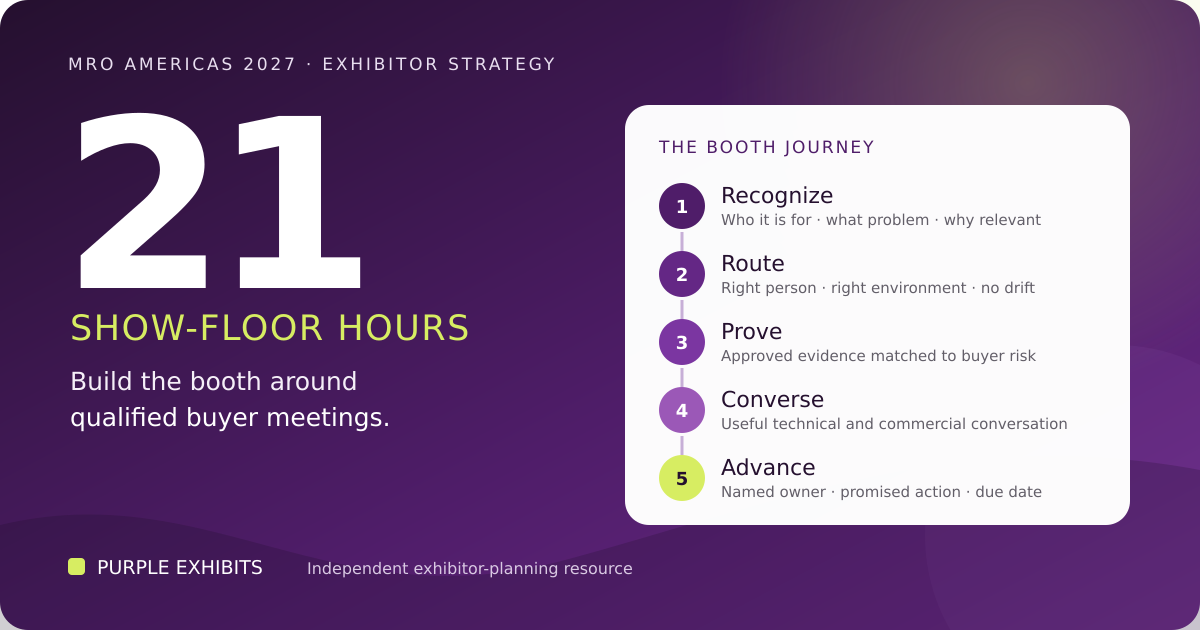
The exhibit hall will be open for 21 hours across three days. During that time, your team may need to recognize a priority account, establish technical relevance, demonstrate a capability, hold a useful conversation, record what matters and secure the next step—while hundreds of other solution providers compete for the same attention.
The booth is where that system becomes physical.
This guide shows aviation exhibitors how to connect target-account planning, messaging, exhibit layout, pre-booked appointments, staff roles, lead capture and follow-up into one buyer-meeting plan for MRO Americas 2027.
Planning the physical exhibit? Read Purple’s complete guide to choosing an MRO Americas 2027 booth builder, including technical displays, costs, EAC coordination, freight, approvals and opening-day execution.
- 21 official show-floor hours
- Organizer-sourced buyer evidence
- Three private planning tools
- Original decision framework
The short answer
A strong MRO Americas exhibitor meeting plan does four things: identifies the accounts the team most needs to meet, gives those buyers an immediate reason to engage, provides the right proof and conversation environment, and assigns every qualified interaction a specific owner and next action. Use the official event app to identify and pre-book relevant contacts, reserve only part of the team’s capacity for appointments, keep room for high-value walk-ins, and align the exhibit experience with the actual conversation sequence.
The 21-hour planning frame
| Show date | Current public exhibit-hall hours | Public minutes | Meeting-plan implication |
|---|---|---|---|
| April 13, 2027 | 9:00 a.m.–5:30 p.m. | 510 | Protect priority appointments while learning which messages and proof create the strongest conversations. |
| April 14, 2027 | 9:00 a.m.–5:30 p.m. | 510 | Use the full day for the highest concentration of scheduled meetings, technical follow-ups and qualified discovery. |
| April 15, 2027 | 9:00 a.m.–1:00 p.m. | 240 | Close open conversations, recover missed priorities and confirm owned next steps before the floor closes. |
| Total | 21 public hours | 1,260 | Capacity must include meetings, walk-ins, transitions, breaks, overruns and note capture. |
The event is scheduled for April 13–15, 2027 at the Orange County Convention Center’s West Concourse in Orlando. Check the official MRO Americas 2027 site and official venue and timing page before finalizing a calendar because dates and hours can change.
Live 2027 competition snapshot: 754 exhibitors already listed
The official MRO Americas 2027 event map displayed 754 exhibitors when reviewed on September 6, 2026. The count is a live directory value, not a final forecast: exhibitors can be added, removed or reassigned before the event. By comparison, the organizer reports 1,075 exhibitors at the completed 2026 show. Those two figures should not be used to predict the final 2027 count or calculate a guaranteed growth rate.
The useful conclusion is simpler. Hundreds of companies already have a place on the floor, so a message such as “quality, service and innovation” is not enough to create recognition. An exhibitor needs to state:
- which MRO buyer or program it serves;
- which operational pressure it can credibly address;
- which proof makes that claim believable; and
- which next conversation the visitor should request.
Use the official 2027 floor plan to understand categories, adjacencies and the current competitive environment. Do not scrape it or use exhibitor information for outreach. The organizer’s exhibitor-list terms state that exhibitor information is provided for attendee product-and-service search and prohibit solicitation. Use existing relationships, consented contacts, public editorial channels and the registered event app in accordance with its current rules.
How this guide was researched
This guide was researched from the current MRO Americas event site, venue-and-timing information, event-app guidance, exhibitor resources, audience information, the completed-2026 post-show report and engagement options, then shaped around the decisions an aviation exhibitor and exhibit partner still need to make. A named Purple reviewer should approve the exhibit-planning guidance before publication.
The organizer is the authority for dates, hours, registration, space, forms, vendors, event tools and current rules. Purple is responsible for the exhibit-planning frameworks on this page. Where a number is a Purple planning assumption rather than an official benchmark, the page labels it that way.
Last reviewed: September 7, 2026. See the source notes and recheck official information before final design, ordering or shipping decisions.
In this MRO Americas exhibitor-meeting guide
- Review the research method
- See the live 2027 competition snapshot
- Use the buyer decision architecture
- Start with the buyer mission
- Build the five-stage booth journey
- Match proof to the buying risk
- Calculate meeting capacity
- Create target-account tiers
- Prioritize conversations
- Build the message ladder
- Use the official event tools
- Run the four-wave outreach plan
- Use the 20-minute meeting agenda
- Assign the show-floor team
- Capture a useful lead record
- Measure what matters
- Set the response plan
- Translate the plan into visitor-experience requirements
- Generate a buyer-meeting plan
- Frequently asked questions
- Review the sources
Choose your fastest path
| If you need to… | Go here |
|---|---|
| Hire or compare an MRO Americas booth builder | Purple’s commercial builder guide |
| Turn meeting decisions into one copyable team plan | Buyer-Meeting Plan Generator |
| Design around decision authority and evidence needs | MRO Buyer Decision Architecture |
| Decide how many appointments the team can support | Meeting-capacity calculator |
| Match the layout to buyer conversations | Five-stage booth journey |
| Prepare the event-app profile and meeting requests | Official event tools |
| Give sales one qualification and follow-up system | Conversation-priority model and response plan |
| Translate the meeting plan into visitor-experience requirements | Meeting-plan handoff |
A full calendar beats a full aisle
MRO Americas is built around face-to-face business across the aviation maintenance ecosystem. The organizer’s current site promotes access to airline technical buyers, procurement teams and senior decision-makers, while the official event platform is designed for prospect filtering, messaging and pre-booked meetings.
That changes the job of the booth.
The goal is not to attract the largest possible crowd. A crowd can block the entrance, overwhelm specialists and make scheduled buyers wait. The goal is to create the right mix of:
- Named-account meetings with buyers, partners and customers the team has selected in advance.
- Qualified discovery conversations with relevant people the team did not know before the show.
- Technical proof moments that make an abstract capability concrete.
- Owned next steps that continue after Orlando.
The assignment is not “get traffic.” It is “make the next right conversation easy to begin and difficult to lose.”
Design for the audience MRO Americas actually attracts
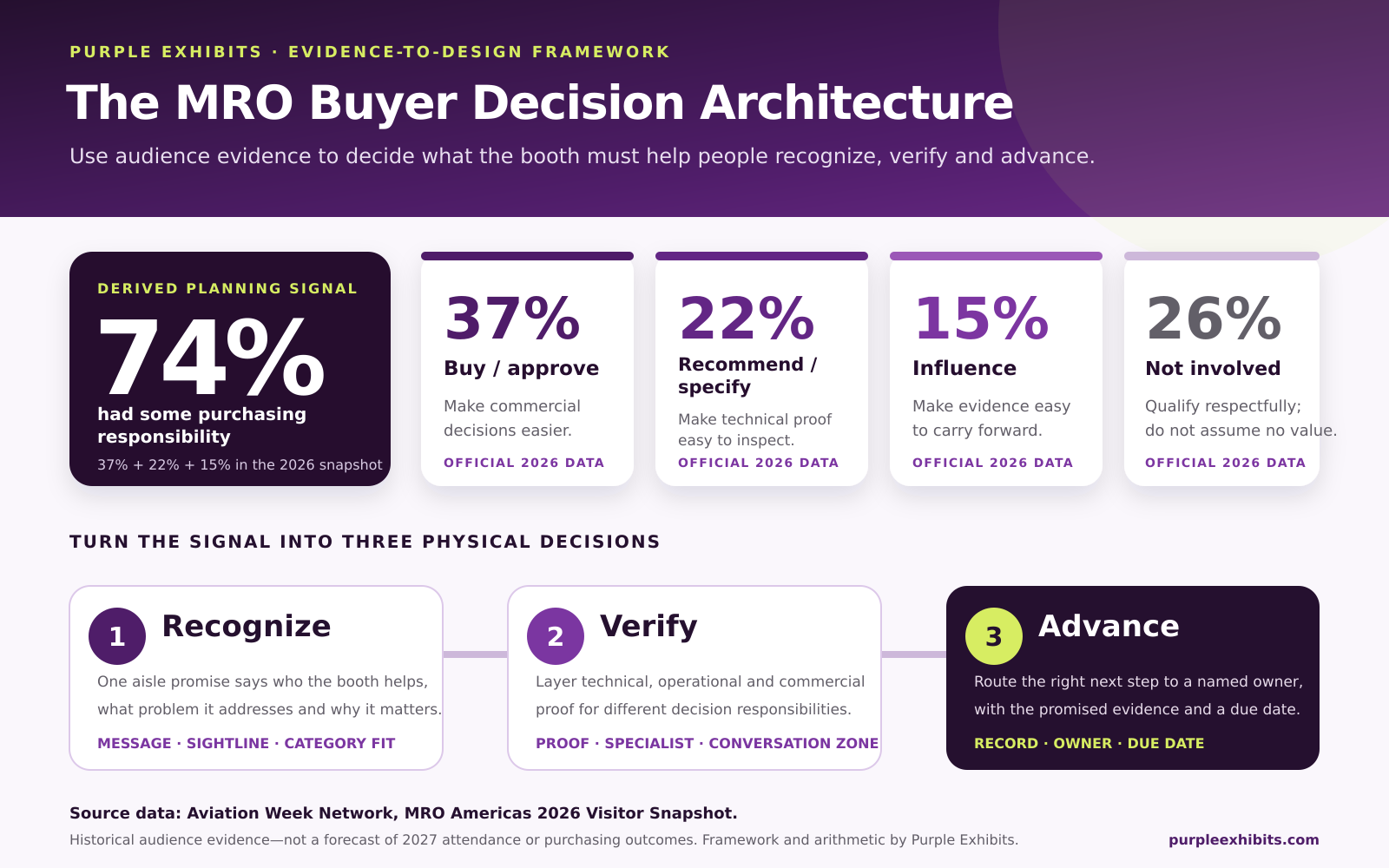
The best available planning evidence is not a generic trade-show benchmark. It is the organizer’s own completed-2026 visitor snapshot. That snapshot reports four levels of purchasing responsibility:
That means 59% were reported in the buy/approve or recommend/specify categories, and 74% were reported in one of the first three purchasing-involvement categories. Those two percentages are transparent arithmetic from the organizer’s four published categories; they are Purple planning signals, not separate organizer claims and not a forecast of the 2027 audience.
The same snapshot shows why one generic pitch is inadequate. Its top job functions include sales and marketing at 22%, executive management at 17%, engineering and maintenance at 17%, business development at 12%, supply chain/logistics at 9% and purchasing/procurement at 6%. Its industry chart is also mixed: MRO represents 26% of the displayed distribution, followed by parts distributors/suppliers at 13%, supply chain/logistics at 10%, OEM/manufacturers and airline operators at 8% each, plus consulting, cabin-interiors and software audiences.
Do not turn those historical percentages into an exact staffing ratio or a 2027 attendance promise. Use them to pressure-test whether the exhibit can serve different decision responsibilities.
The Purple MRO Buyer Decision Architecture
| Decision layer | What a visitor must be able to do | What the physical exhibit must provide | What the team must record |
|---|---|---|---|
| Recognize | Decide from the aisle whether the company is relevant to their fleet, program, capability gap, workflow or supply need | One buyer-recognizable promise, visible category language, relevant platforms or capabilities and an obvious place to begin | Visitor type, account and the reason the message earned attention |
| Verify | Examine the evidence appropriate to their role and decide whether a deeper conversation is warranted | Layered technical, operational and commercial proof; access to the correct specialist; open, semi-private or enclosed conversation space based on the subject | Need, timing, authority or stakeholder path, proof requested and unresolved question |
| Advance | Agree to the next decision that can responsibly happen after the show | A low-friction close, calendar access when appropriate, shareable evidence and no ambiguity about who owns the promise | Exact next action, named owner, due date, consent status and promised material |
The architecture prevents two common mistakes. First, it avoids treating everyone with purchasing influence as though they need the same proof. A technical specifier may need supported data and an engineering follow-up; an approver may need capacity, commercial scope and risk clarity; an influencer may need a concise evidence package that can survive an internal handoff. Second, it avoids treating the organizer’s 26% “not involved” category as unqualified. That category may include users, partners, media, service providers or other relevant participants—it only says they reported no purchasing responsibility.
Four exhibit decisions to make from the data
- Give the aisle one promise, not four departments. The message should establish category fit before it asks the visitor to choose a business unit.
- Layer proof by decision responsibility. Place fast credibility cues in the aisle, inspectable technical evidence at the demonstration or product point, and detailed commercial material where a qualified conversation can continue.
- Staff the handoff, not only the greeting. At minimum, define who can qualify, who can explain technical evidence, who can discuss commercial scope and who owns the post-show action. One person may cover more than one role, but no role should be ownerless.
- Prepare for international continuity. The organizer’s 2026 snapshot lists the United States, United Kingdom, Canada, France, Germany, Ireland, Brazil, Netherlands, Japan and Denmark as its top attending countries. Record region, operating context, time zone and the correct follow-up owner when they affect the next step.
Use the official MRO Americas 2026 visitor snapshot as the source for the historical percentages and country list. The booth-design interpretation, combined percentages and three-layer framework are Purple Exhibits analysis.
Start with the buyer mission—not the display features
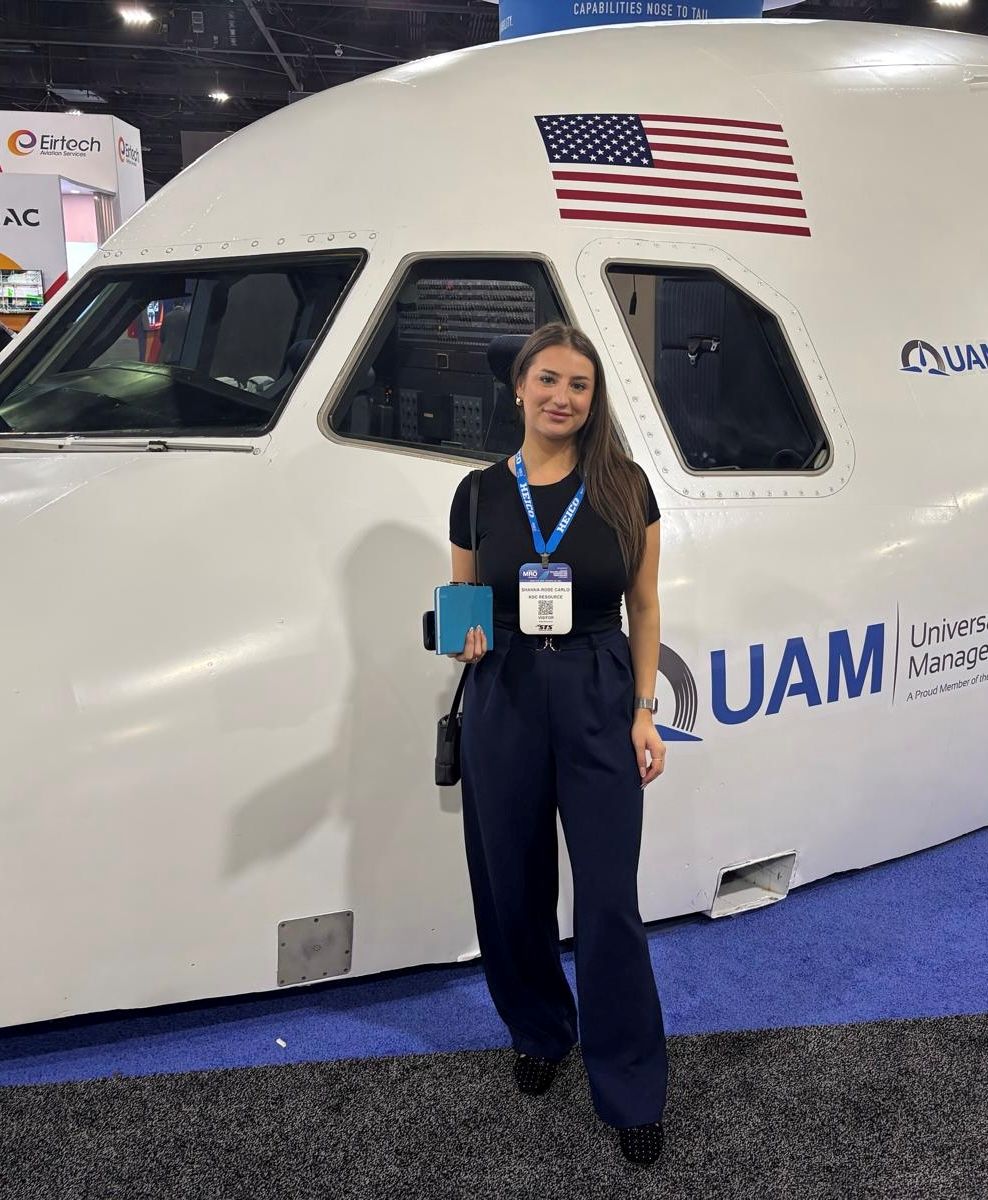
Different MRO Americas visitors evaluate different forms of risk and value. One general headline cannot speak equally well to an airline maintenance leader, a procurement manager, a lessor, an OEM program team and a repair-station partner.
Before approving campaign or exhibit messaging, select the two or three buyer missions the team must serve most clearly.
The MRO buyer-mission matrix
| Priority audience | Question likely behind the visit | What the meeting experience should make easy to verify | Strong next step |
|---|---|---|---|
| Airline maintenance or engineering | Does this fit our fleet, technical requirement and operating reality? | Applicable platforms, technical scope, approvals, documented performance and access to a qualified expert | Technical review with the correct engineering or program owner |
| Procurement or supply chain | Can this supplier reduce risk around availability, lead time, cost or continuity? | Coverage, capacity, availability, locations, commercial model and credible fulfillment proof | Capability-and-sourcing follow-up with an agreed data request |
| OEM or program partner | Can this company support our standards, scale and integration requirements? | Quality systems, relevant capabilities, capacity, process control and program fit | Program-specific qualification conversation |
| Lessor or asset manager | Will this protect asset value, records integrity and lifecycle flexibility? | Traceability, documentation, coverage, turnaround approach and lifecycle support | Asset or fleet-specific review |
| MRO or repair-station partner | Can this company extend our capabilities, capacity or geographic reach? | Complementary scope, overflow capacity, locations, handoff process and turnaround expectations | Partner-fit meeting with capability exchange |
| Technology or software buyer | Will this work inside our maintenance workflow and systems environment? | A completed workflow, integration context, security answers, implementation path and offline demonstration backup | Technical discovery or sandbox/demo follow-up |
| Military or government aviation | Can this support readiness, sustainment and the applicable procurement environment? | Relevant eligibility, supported platforms, compliance boundaries, logistics and program experience | Appropriate program or contracting follow-up |
This matrix is a planning tool, not a claim that every visitor follows the same buying process. Adapt it to the exhibitor’s real products, certifications, approved claims and sales stages.
The one-buyer rule
For every major message, proof point or visitor interaction, finish this sentence:
This exists so [specific visitor] can understand or do [specific thing] and move to [specific next step].
If an element cannot complete that sentence, it may be competing with the work the meeting plan needs to do.
Plan each buyer interaction as a five-stage journey
Aviation exhibitors often have deep capabilities and limited time to explain them. The physical environment should reduce the distance between “What does this company do?” and “We should continue this conversation.”
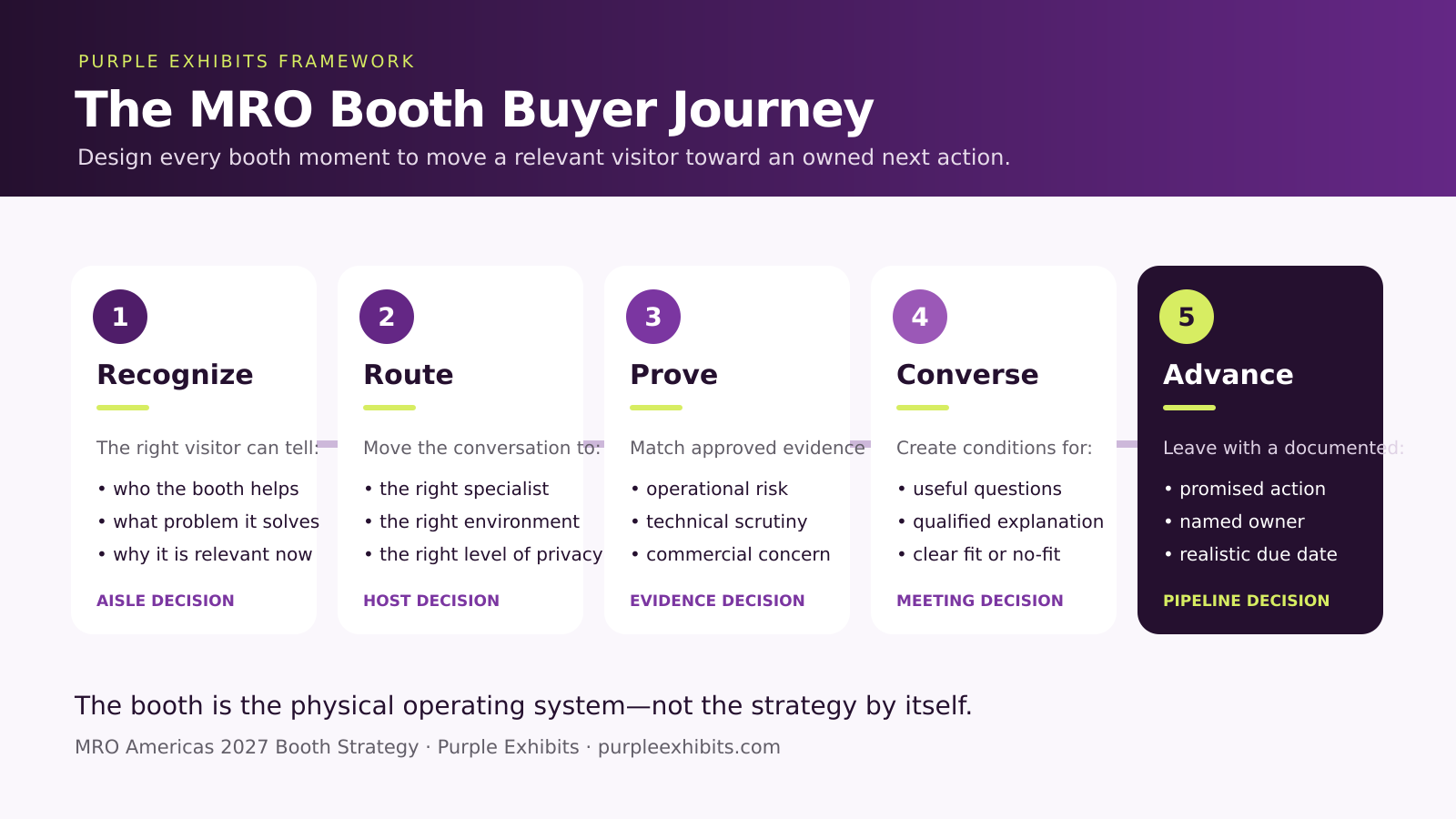
1. Recognize
From the aisle, the right visitor should be able to identify three things without reading a paragraph:
- Who the company helps
- What problem or capability it owns
- Which platforms, product families, services or workflows are relevant
Use one primary promise, a small number of proof cues and visible category language. Do not make an airline buyer decode internal business-unit names.
2. Route
The entrance must help staff distinguish among a scheduled guest, a customer, a qualified new prospect, a partner, media and a general visitor. The route may lead to a demonstration, product display, technical specialist, open conversation area or private meeting.
Reception should not become a wall. A greeting point needs sightlines, a clear handoff path and access to the day’s meeting calendar.
3. Prove
The booth should answer the buyer’s next reasonable question with the strongest approved form of proof available:
- A physical component or cutaway
- A live or recorded workflow
- Supported fleet or platform information
- Approved turnaround, coverage or capacity data
- A traceability or quality-process visual
- A customer example that Purple has permission to display
- A technical expert who can answer without improvising unsupported claims
The proof should be legible, specific and close to the conversation it supports.
4. Converse
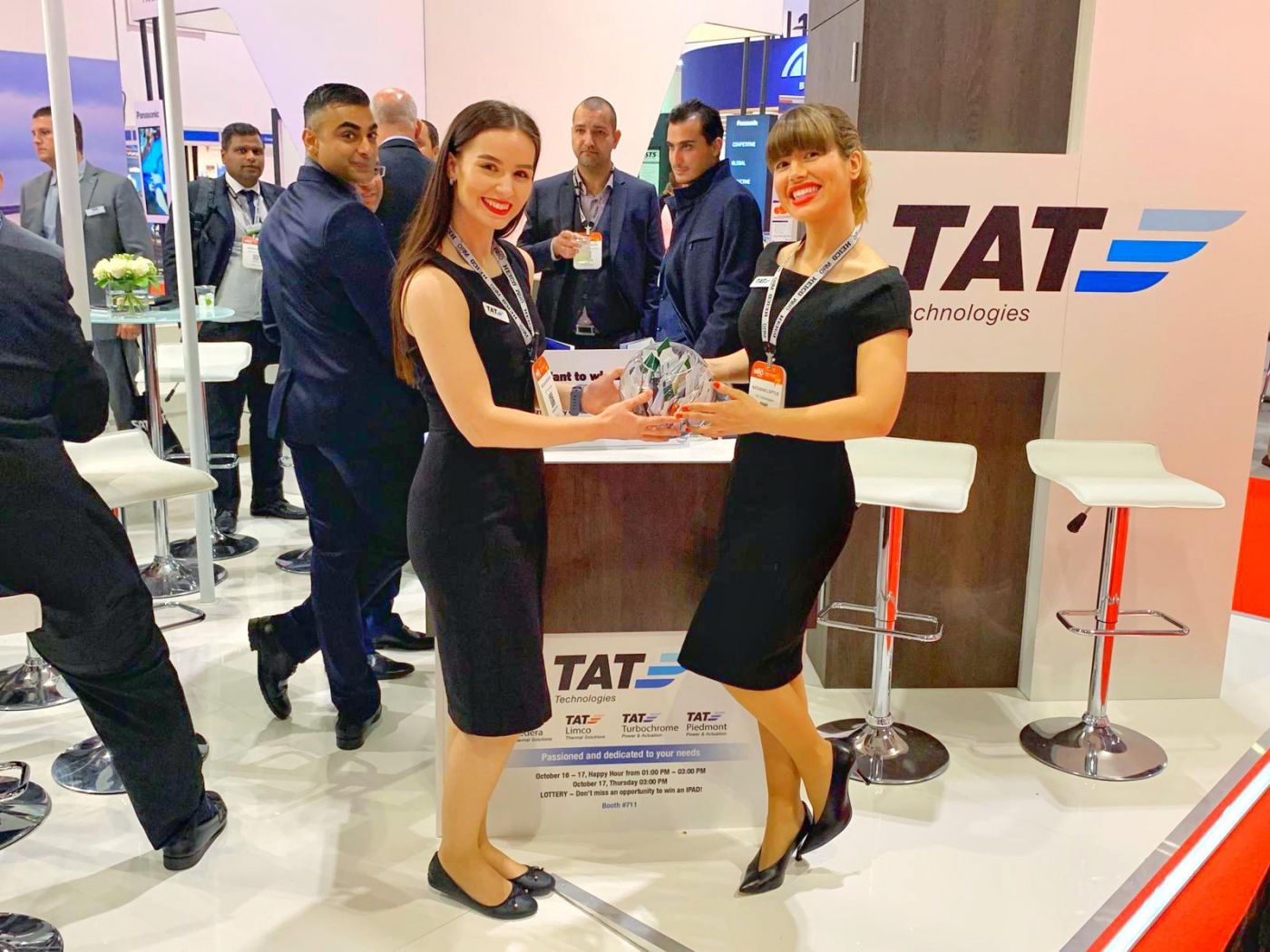
Not every interaction needs a closed room. Match the environment to the conversation:
- A two-minute qualification needs an open standing position.
- A ten-minute product explanation may need a screen, counter and side-by-side viewing.
- A scheduled commercial conversation may need seating and acoustic separation.
- A sensitive program, pricing or technical discussion may justify a private room.
Design for the number and type of simultaneous conversations—not an abstract request for “more seating.”
5. Record and advance
The handoff is incomplete until the team records why the person mattered, what was discussed, what was promised, who owns the next action and when it is due.
A badge scan is contact data. A qualified lead record is business context.
The Purple buyer-journey test
Walk through the proposed layout and answer:
- What does a priority buyer see first?
- Where does a scheduled guest check in?
- Who qualifies an unscheduled visitor?
- Where does each core proof moment happen?
- Can a technical demo run without blocking entry?
- Can a private meeting begin without crossing another meeting?
- Where do staff record notes without abandoning the visitor?
- What happens when every specialist is occupied?
If the team and proposed visitor experience cannot answer those questions, the buyer-meeting plan is not ready.
Match the proof to the MRO buying risk

Technical buyers rarely need more adjectives. They need the right evidence for the risk they are evaluating. Plan each proof point with the exhibitor’s engineering, quality, legal and commercial owners before it becomes booth copy.
| Buyer risk | Useful booth evidence when approved | Weak substitute to avoid |
|---|---|---|
| Platform or fleet fit | Supported aircraft, engine, component, system or application scope with clear boundaries | A generic aviation image that implies broader coverage |
| Quality and compliance | Current certificates, approval scope, traceability example or quality-process visual | An unexplained badge wall or expired certificate |
| Turnaround and availability | Defined process, capacity context, inventory visibility or documented service commitment | “Fastest” or “always available” without a basis |
| Technical performance | Specification, test method, before/after evidence or an approved customer example | A superlative without the conditions behind it |
| Integration and implementation | A real workflow, architecture view, supported interfaces and an offline demo fallback | A looping interface video with no usable scenario |
| Supply continuity | Locations, qualified capacity, alternate-path logic and a credible escalation process | A map with pins that do not represent active capability |
| Program execution | Named roles, milestones, handoffs and relevant program experience | “Turnkey” without a written responsibility map |
| Asset or records integrity | Documentation flow, traceability controls and lifecycle context | A promise that cannot be demonstrated at the booth |
For every major claim, record four things in the show book: the exact approved wording, the proof displayed, the person authorized to explain it and the next step if a buyer requests deeper evidence.
This protects credibility and makes the exhibit easier to design. Purple can create the structure, sightline and interaction around the proof; the exhibitor must validate the underlying technical claim.
Calculate realistic MRO Americas meeting capacity
MRO Americas 2027 currently lists 21 public exhibit-hall hours. That sounds generous until meetings, walk-ups, demos, breaks, late arrivals, room resets and staff availability begin competing for the same time.
One meeting station running 30-minute conversations has a mathematical ceiling of 42 sessions across 21 hours. That is not a realistic booking target because it assumes perfect use with no breaks, transitions, no-shows or walk-in demand.
Use the calculator below to create a planning scenario.
Purple planning tool
MRO Americas Meeting Capacity Planner
Test how meeting stations, conversation length and realistic utilization affect the booth’s working capacity across the currently scheduled 21 show-floor hours.
Your target requires approximately 40% utilization with these inputs.
The scenario preserves working room for transitions and qualified walk-ins. Test it against actual staff coverage before booking.
Planning estimate only. Results do not predict attendance, meetings, leads, sales or return on investment. Recheck official show hours before relying on the 1,260-minute setting.
How to use the result
- Theoretical slots show what the booth could hold if every selected station ran continuously.
- Working capacity applies the utilization assumption selected by the user.
- Scheduled target should leave intentional capacity for transitions, priority walk-ins and overruns.
- Capacity gap warns when the desired target cannot fit the current number of stations and meeting length.
A utilization assumption is a planning choice, not an industry benchmark or performance promise. Start conservatively, compare it with the team’s actual show history and test the schedule against staff availability.
Capacity changes the schedule and staffing plan
If the plan requires three concurrent scheduled meetings, the team needs more than three open calendar slots. It needs:
- Three usable conversation environments
- Hosts and subject-matter experts who can cover them
- A check-in and delay plan
- Space for early arrivals
- A way to handle qualified walk-ups
- Access to the proof, product or demonstration required for each meeting type
- A reset and note-capture process
The calendar, staff roster and available conversation environments must agree. The separate commercial builder guide explains how to turn those requirements into a physical floor plan.
Build three target-account tiers before the app opens

Do not wait for the attendee directory to decide who matters. Define the account logic first; then use the official event platform within its rules to identify relevant people.
Tier 1: Must-meet named accounts
These are specific customers, prospects, programs or partners for which a meaningful meeting could materially change the value of the show.
For each Tier 1 account, record:
- Why the account matters now
- The likely visitor roles
- The MRO problem, program or initiative that makes the meeting relevant
- The right person from your team
- The proof or expert the booth must provide
- The meeting outcome you want
- A backup contact and backup time
Tier 1 outreach should be personal. A generic blast is not account strategy.
Tier 2: Strategic-fit profiles
These accounts fit a defined profile but may not yet have a known project. Examples might include airlines operating a relevant fleet, repair stations needing complementary capability, lessors with a particular asset class or technology teams using a compatible system.
Create filters and qualification questions that help the team recognize them.
Tier 3: Discovery
These are relevant visitors whose need or timing is not yet known. The booth should make it easy to identify fit without trapping either person in a long, low-value conversation.
The account-plan rule
Every tier needs a different action:
- Tier 1 → scheduled meeting with a defined outcome
- Tier 2 → targeted invitation and qualified conversation
- Tier 3 → fast discovery, correct routing and permission-based follow-up
Do not treat all scans as equal. That makes the final lead report look larger while making the sales queue less useful.
Prioritize conversations with the Purple 10-point model

When several visitors need attention at once, the team needs a shared definition of priority. Use this lightweight model after an initial conversation; do not use appearance, seniority alone or personal familiarity as a substitute for fit.
Score each factor 0, 1 or 2:
| Factor | 0 | 1 | 2 |
|---|---|---|---|
| Account fit | Outside the agreed profile | Possible or adjacent fit | Named account or clear ideal-customer fit |
| Need and timing | No relevant need identified | Relevant issue, timing unclear | Active or time-bound requirement |
| Role and path | No known connection to the decision | Influencer or path to stakeholders | Decision owner, technical evaluator or direct access to them |
| Proof match | No relevant proof identified | General capability is relevant | Specific approved proof directly answers the need |
| Next-step clarity | No agreed continuation | Permission to follow up | Named action, owner and target date agreed |
Conversation priority score = fit + need/timing + role/path + proof match + next-step clarity
- 8–10: Priority A. Record complete notes, assign the owner and deliver the promised action to the agreed timing.
- 5–7: Priority B. Clarify the missing fit, stakeholder, timing or proof before routing into a broad nurture sequence.
- 0–4: Priority C. Close the conversation respectfully, capture only permissioned data and avoid manufacturing urgency.
Purple planning tool
Conversation Priority Scorer
Select 0, 1 or 2 for all five factors. Use the table above to define each number consistently.
Complete every factor
The score will classify the conversation after all five factors are selected.
This score supports human judgment. Existing customers, safety issues, regulatory matters and contractual commitments may require immediate ownership regardless of score.
Override rules
A score supports judgment; it does not replace it. Existing customers, safety-related issues, regulatory matters, active contractual obligations and executive commitments may require immediate ownership regardless of score. A high score also does not authorize unsupported claims, inappropriate data collection or outreach without permission.
Use the same five fields in the badge-scanning notes or CRM mapping so priority does not disappear during handoff.
Create a message ladder that works at three speeds
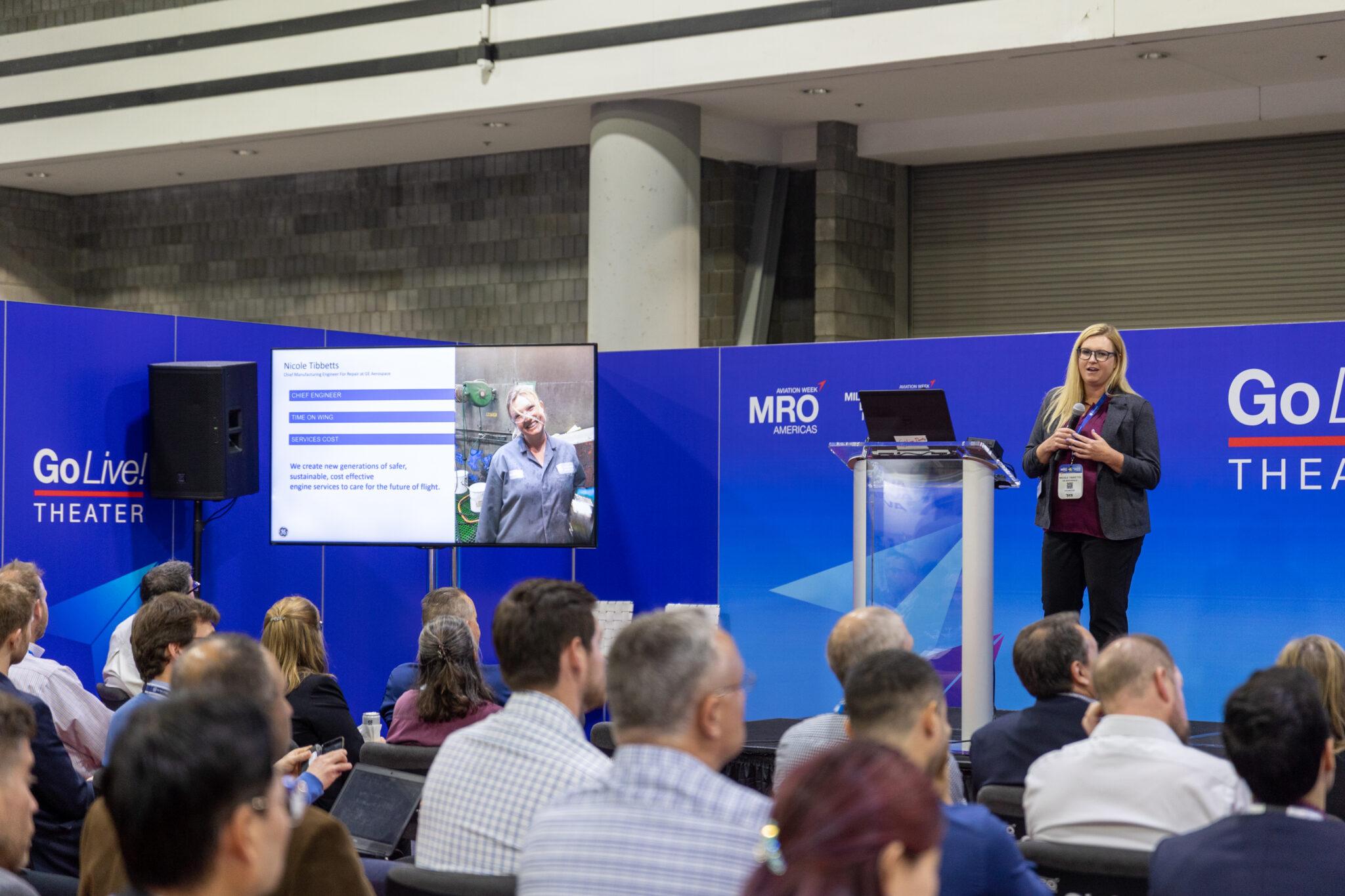
The same capability needs different levels of explanation at the aisle, the demo and the meeting table.
Eight-second aisle message
Formula:
We help [specific aviation customer] solve [specific operational problem] across [relevant scope, platform or workflow].
Example structure—not a claim to copy:
Component repair support for operators that need clearer turnaround visibility across [supported product family].
The exact statement must match the exhibitor’s approved capability and evidence.
Thirty-second qualification
Use a question that reveals fit:
- Which fleet, component family or maintenance program is driving the priority?
- Is the current pressure availability, turnaround, capacity, cost, compliance or visibility?
- Are you evaluating for an active requirement, a future program or partner coverage?
- Who else needs to be involved in the technical or commercial review?
The question should earn the next minute—not interrogate the visitor.
Three-minute proof story
Build the explanation in four parts:
- Context: the exact buyer or operating situation
- Problem: the risk, delay or constraint
- Proof: the approved capability, workflow, example or demonstration
- Next step: the specific continuation that makes sense
Meeting-level depth
Prepare separate proof packets for the conversations the team expects:
- Technical capability
- Quality and approvals
- Capacity and turnaround
- Fleet or platform relevance
- Implementation or integration
- Commercial structure
- Program partnership
Do not force every visitor through the same deck. The best meeting content begins where the buyer’s real question begins.
The message consistency check
The aisle graphic, app profile, product listing, outreach message, staff opener, demonstration and follow-up email should describe the same value in compatible language. If each channel sounds like a different company, recognition is lost.
For the broader, show-agnostic campaign framework, use Purple’s trade show marketing strategy guide. This article applies that discipline specifically to MRO Americas buyer meetings.
Use the official MRO Americas tools as part of the campaign

The booth cannot do all the discovery by itself. MRO Americas currently provides digital and promotional tools that can extend the exhibitor’s reach before, during and after the floor opens.
Build the event-app profile for search and decisions
The official MRO Americas event platform lets registered users browse and filter attendees, exhibitors, products and sessions, send messages and pre-book meetings.
Prepare the profile before access arrives:
- One precise company description
- Clearly named products, services or capabilities
- Search language used by buyers—not only internal product names
- Supported platforms or categories when approved and relevant
- A reason to meet at MRO Americas
- The booth number when assigned
- The correct team members and profile photos
- A direct, low-friction meeting invitation
The organizer presently says exhibitors receive platform access approximately one month before the event and attendees approximately two weeks before it. Its current FAQ also says meeting requests can be sent only to active participants on desktop, interest categories help matchmaking, a standard exhibitor can upload two products and an enhanced exhibitor can upload ten, with a 1000×1000-pixel product image recommended. Treat every package limit and timing as current guidance—not a permanent 2027 entitlement—and verify it when access arrives.
Turn each product listing into a buyer decision page
Do not upload “Product 1” and a brochure cover. For each permitted listing, provide:
- A buyer-recognizable product or capability name
- The exact operating problem or application it addresses
- Supported platform, component, workflow or customer type when approved
- One credible proof cue
- A clear reason to meet at the booth
- A square, legible image that remains understandable at thumbnail size
Use separate listings for meaningfully different buyer missions. Do not split one capability into thin variations merely to occupy every available slot.
Use prospect filters before sending messages
Create a saved account logic outside the app, then apply available filters inside it. A useful search can combine:
- Company type
- Role or job function
- Geography
- Product or capability interest
- Named company
- Relevant session or topic
Use the platform for one-to-one connection as intended. The organizer’s FAQ says the attendee list cannot be downloaded or exported from the app. Do not scrape it, buy a suspicious “attendee list” or upload contacts into unrelated campaigns without a lawful basis and appropriate permission.
Evaluate Lead Insights against the sales workflow
The current Lead Insights page describes lead consolidation, scoring, behavioral data, segmentation and customizable exports. Before purchasing or relying on it for 2027, confirm:
- Whether it is included in the exhibitor’s current package
- Which pre-event and on-site interactions it captures
- What fields can be exported
- Whether the export maps cleanly to the CRM
- Who will monitor and act on the data
- The 2027 price and terms
A dashboard does not create follow-up. An owner and response standard do.
Use official promotion to support—not replace—personal outreach
The organizer’s engagement-opportunities page currently describes social-sharing tools, the official #MROAM hashtag, publicity opportunities and exhibitor guest invitations. Confirm which opportunities and links are active for 2027.
General social promotion creates awareness. Named-account outreach creates meetings. Use both for their proper jobs.
Run a four-wave MRO Americas meeting campaign
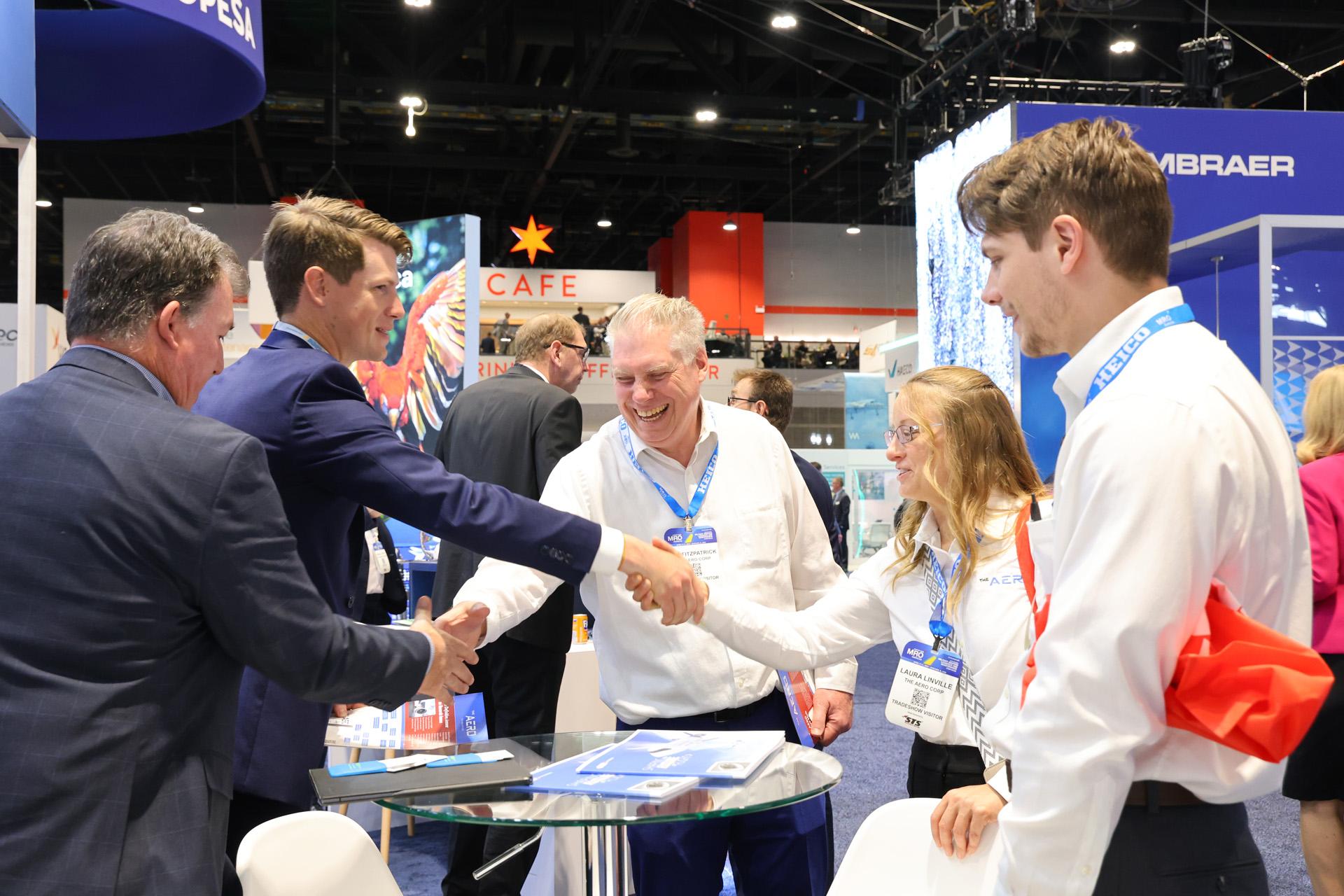
The timing below is a Purple planning framework, not an official MRO Americas deadline schedule.
Wave 1: Relevance
Begin after the show commitment and core exhibit objective are confirmed.
- Define Tier 1 accounts and Tier 2 profiles.
- Select the two or three buyer missions the booth will prioritize.
- Write the core message ladder.
- Decide what meeting types the booth must support.
- Create a short MRO Americas landing path with booth number marked “coming soon” until assigned.
- Give salespeople a reason to begin relevant one-to-one conversations without pretending the final calendar is open.
Wave 2: Invitation
Begin when the offer, booth experience and likely team are clear.
- Invite customers and active prospects personally.
- Announce what the team will demonstrate or discuss.
- Offer two or three specific meeting windows instead of “stop by sometime.”
- Coordinate account ownership so the same person does not receive competing invitations.
- Prepare app-profile text, product listings and team bios before platform access.
Wave 3: Booking
Accelerate when official app access and attendee networking open.
- Complete the official profile immediately.
- Filter and prioritize relevant people inside the platform.
- Send short, specific meeting requests tied to a real business reason.
- Build buffers around executive, technical and product-demo meetings.
- Keep meaningful space for qualified walk-ins rather than booking every theoretical slot.
- Track accepted, tentative, declined and unanswered invitations separately.
Wave 4: Confirmation and conversion
Run through show week and the post-show handoff.
- Confirm each meeting with date, time, booth number, host and purpose.
- Give every host a one-page account brief.
- Reconfirm any proof, sample, expert or demonstration required.
- Record the outcome and promised action before the next meeting begins.
- Send urgent promised material as soon as practical.
- Route every qualified record into the CRM with an owner and due date.
Copy-and-personalize outreach scripts
Existing customer or active prospect
Subject: MRO Americas: time to review [specific program or priority]?
Hi [Name],
Our team will be at MRO Americas in Orlando, April 13–15. Since we have been discussing [specific initiative, fleet, capability or problem], I would like to reserve time with [relevant expert] to review [specific outcome].
Would [option one] or [option two] work? We will be at booth [number]. If another topic is more useful, tell me and I will bring the right person.
[Name]
New contact through the official event app
Hi [Name]—I noticed your role in [specific relevant area]. At MRO Americas, we are focusing on [specific, supportable capability] for [relevant customer type]. If [problem or initiative] is on your 2027 agenda, would a 20-minute conversation at booth [number] be useful? I can include our [technical/commercial/program] lead.
LinkedIn invitation
We will be at MRO Americas in Orlando and are preparing conversations around [specific issue]. Your work in [relevant area] made me think the discussion could be useful. If it is relevant to your priorities, I would be glad to coordinate a short meeting at the show.
Post-meeting follow-up
Subject: The [specific item] we agreed at MRO Americas
Hi [Name],
Thank you for the conversation about [specific issue]. You asked for [specific item], and we agreed that [person] would [action] by [date].
[Link or attached item]
The next useful step appears to be [specific next action]. Does [date/time] work, or should we include [role/team] first?
[Name]
These scripts are frameworks. Personalize every material line. Do not add a fake reference to a person’s business or imply research that was not performed.
Use a 20-minute MRO buyer-meeting agenda
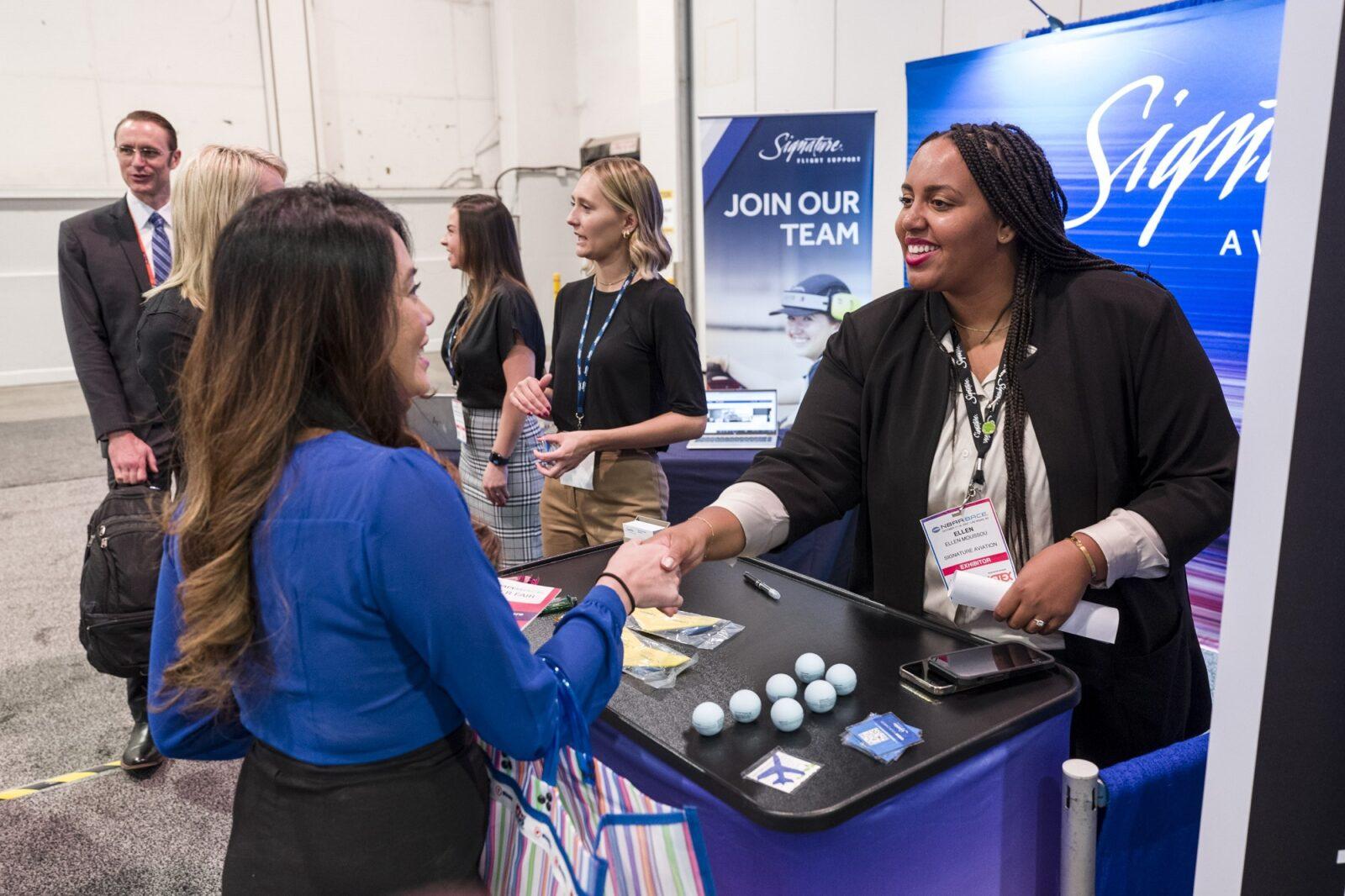
A scheduled meeting should not become an abbreviated company presentation. Send the purpose in advance and use a short agenda that protects time for the buyer’s context.
| Time | Job | Prompt |
|---|---|---|
| 0–2 minutes | Confirm purpose | “We reserved this time to review [specific issue]. Is that still the most useful outcome?” |
| 2–7 minutes | Understand operating context | Clarify fleet, component, workflow, current constraint, timing and stakeholders |
| 7–13 minutes | Present only relevant proof | Show the approved capability, example, workflow or specialist response that fits the stated issue |
| 13–17 minutes | Test fit and surface gaps | Confirm what must be validated, who else should be involved and what could stop progress |
| 17–20 minutes | Own the next step | Name the deliverable, owner, recipient and target date; record it before the meeting ends |
One-page account brief for the host
Prepare a single page—not a research dump—with:
- Account, attendees and roles
- Relationship owner and current status
- Reason the meeting matters now
- Relevant fleet, platform, program, product or workflow
- Approved proof to bring
- Questions that must be answered
- Desired next step and acceptable alternative
- Sensitive subjects or claims that require the correct expert
- Host, backup host and note owner
If a meeting needs a technical specialist, sample, live system, private room or commercial authority, the calendar invitation should say so. The booth cannot route correctly when the appointment title is only “MRO meeting.”
Assign the show-floor team by visitor moment

Job titles do not create coverage. Positions and handoffs do.
| Visitor moment | Primary responsibility | What success looks like |
|---|---|---|
| Recognize and welcome | Front-of-booth host or rotating team member | Scheduled guests are identified; relevant walk-ups are acknowledged quickly |
| Qualify and route | Trained qualifier | The visitor reaches the correct specialist or receives a respectful next action |
| Demonstrate and prove | Product or technical specialist | The visitor sees the proof relevant to the stated need; unsupported claims are avoided |
| Advance the business conversation | Account owner or sales lead | Need, timing, stakeholders and next step are made specific |
| Control the floor | Booth captain | Calendar, coverage, breaks, room use, problems and VIP arrivals stay coordinated |
| Record and hand off | Conversation owner, supported by lead-capture process | Notes, promise, owner and due date enter the system before context disappears |
One person may cover more than one function during a quiet period. Do not assign one person to two simultaneous moments.
The 12-minute opening huddle
Before the hall opens, cover only what changes behavior:
- Today’s Tier 1 guests and arrival times
- Meeting host and backup for each
- Demonstrations, proof and content required
- Known customer or media visits
- Staffing rotations and breaks
- Yesterday’s open promise that affects today
- One message correction based on real visitor questions
The 12-minute closing huddle
Before the team disperses:
- Confirm every high-priority meeting has notes.
- Identify promises due before the next morning.
- Escalate any product, content or booth issue.
- Adjust tomorrow’s coverage based on traffic and appointments.
- Name the most important lesson from the day.
For the broader role-comparison and staffing-capacity method, use Purple’s trade show staffing role guide. If outside hosts, ambassadors or lead staff are required, use Purple’s trade show staffing services.
Capture a lead record that sales can use
Every qualified MRO Americas interaction should answer the questions below. Not every field has to be asked aloud; some come from registration data, preparation or the conversation.
Minimum useful record
- Person, role, company and contact details
- Account tier or target profile
- Fleet, platform, component, capability or workflow involved
- Business problem or initiative in the visitor’s own terms
- Current stage: discovery, active evaluation, sourcing, technical review, partner discussion or customer expansion
- Timing or triggering event
- Relevant stakeholders not present
- Proof, document, sample, pricing or expert requested
- Agreed next action
- Named owner
- Due date
- Permission and preferred channel for follow-up where required
MRO-specific qualification prompts
Use only the questions relevant to the conversation:
- Which aircraft, engine, component family, system or facility does this involve?
- Is the priority driven by availability, turnaround, cost, capacity, quality, compliance, data visibility or another constraint?
- Is there an active requirement or are you mapping future capability?
- What must be validated before the next internal decision?
- Which technical, quality, procurement or program stakeholders should join the next step?
- What timing would make a solution useful?
The promise field
Add one required CRM field labeled What did we promise?
This prevents “send information” from becoming an ownerless task. A useful answer names the exact item, person and date.
For broader process guidance, see Purple’s trade show lead-generation guide.
Measure the meeting system—not the pile of scans
Select metrics before the show so the team does not redefine success afterward.
Pre-show metrics
- Tier 1 accounts identified
- Relevant contacts identified within permitted official tools
- Personalized invitations sent
- Meeting acceptance rate
- Meetings confirmed
- Meetings with the correct expert assigned
On-site metrics
- Confirmed-meeting show rate
- Tier 1 accounts met
- Qualified unscheduled conversations
- Technical demonstrations completed
- Meetings that produced an agreed next step
- Promises entered with owners and due dates
- Capacity conflicts, wait times and no-shows
Post-show metrics
- Follow-ups completed on time
- Technical or commercial next meetings booked
- Sales-accepted opportunities
- Pipeline created or influenced, using Purple’s actual CRM definitions
- Existing-account expansion or retention actions
- Cost per qualified meeting
- Cost per sales-accepted opportunity
- Lessons applied to the next event
Useful formulas
Meeting acceptance rate = accepted meeting requests ÷ valid personalized requests
Meeting show rate = completed scheduled meetings ÷ confirmed scheduled meetings
Next-step rate = qualified conversations with an agreed next action ÷ qualified conversations
Cost per qualified meeting = total attributable show investment ÷ qualified meetings completed
Opportunity conversion rate = sales-accepted opportunities ÷ qualified conversations
Define “qualified,” “sales accepted,” “pipeline created” and “influenced” before calculating. Otherwise, two departments can report different results from the same show.
Purple’s trade show ROI guide provides a broader measurement framework.
Set the response plan before the first badge is scanned

“Follow up quickly” is not an operating rule. Define the trigger, owner and completion evidence for each class of conversation before the show.
| Conversation class | Response standard to approve internally | Owner | Completion evidence |
|---|---|---|---|
| Safety, AOG, active operational disruption or contractual issue | Escalate immediately through the exhibitor’s approved operational channel | Named operational or account owner | Accepted handoff and next communication time |
| Priority A with a promised item | Deliver to the agreed time; if no time was agreed, assign one before show close | Conversation owner | Exact item sent and next action recorded |
| Scheduled customer or Tier 1 meeting | Complete notes and owner assignment the same day | Meeting host | CRM record plus named next step |
| Priority B requiring qualification | Send a specific clarification or relevant proof after notes are reviewed | Assigned sales owner | Question answered or follow-up meeting proposed |
| Priority C or general interest | Use permission-based nurture only when relevant | Marketing owner | Correct consent status and segment |
| Media, association or partner conversation | Route to communications or alliance owner; do not bury it in the sales queue | Named communications/partner owner | Acknowledgment and agreed action |
These are planning categories, not universal service-level benchmarks. Purple’s client should set exact hours according to its sales process, time zones, compliance requirements and account commitments.
The no-orphan rule
A lead is not handed off until the next owner accepts it. “Assigned in the CRM” is not the same as accepted. Review unaccepted Priority A records at the daily close and again on the first business day after the show.
The MRO Americas buyer-meeting readiness check
Score each statement Yes, Partial or No:
- We have selected the two or three buyer missions the booth serves first.
- Our Tier 1 accounts have named owners and a reason to meet now.
- Our aisle message states who we help and what relevant problem we solve.
- Every major claim has approved proof.
- The app profile and booth message use compatible language.
- The number of meeting environments matches the appointment target.
- We have preserved capacity for qualified walk-ins and schedule overruns.
- Every visitor moment has a staffed owner and backup.
- The lead record captures business context, not only contact data.
- Every promised action requires an owner and due date.
- The CRM routing and response standards are agreed before the show.
- The exhibit team has received the approved meeting, demonstration, privacy and visitor-flow requirements.
- Every material technical or performance claim has approved proof and an authorized explainer.
- The team uses one shared conversation-priority definition rather than scan count alone.
- Priority records cannot become orphaned between the show floor and the next owner.
Any No attached to a Tier 1 meeting, unsupported claim, required expert, critical demonstration or lead handoff is a priority fix.
Printable command card
MRO Americas 2027 Buyer-Meeting Plan
April 13–15, 2027 · OCCC West Concourse · Orlando
Readiness check
Planning worksheet by Purple Exhibits. Verify current event rules and schedules with MRO Americas. Purple is an independent exhibit company and is not affiliated with or endorsed by the organizer.
This conversion check complements—but does not replace—the technical 100-point readiness scorecard in Purple’s MRO Americas booth-builder guide.
Translate the meeting plan into visitor-experience requirements
The sales and marketing team should agree on what must happen during each priority interaction before the physical exhibit is finalized.
Document:
- Priority buyer groups and named accounts
- Scheduled-meeting target, typical duration and intentional walk-in capacity
- Number of simultaneous conversations the staff can support
- Open, semi-private and private conversation needs
- Demonstrations and approved proof required for each buyer mission
- Hosts, technical specialists and backup coverage
- Scheduled-guest, early-arrival and specialist-handoff procedures
- Qualification questions and the notes required after each conversation
- The preferred next action, response owner and delivery standard
- Accessibility, language, confidentiality and demonstration constraints
- A fallback when rooms, staff or technology are unavailable
Generate the team’s working plan
Use the Buyer-Meeting Plan Generator below to turn target accounts, appointment capacity, proof, staffing, qualification and follow-up decisions into one copyable document for the internal show team. It intentionally excludes booth configuration, custom-versus-rental selection, reusable exhibit assets, budget, vendor scope, freight, show services and quote preparation.
Private browser-based planning tool
MRO Americas Buyer-Meeting Plan Generator
Turn target-account, appointment, proof, staffing and follow-up decisions into one working plan for the sales and marketing team. Complete the fields not marked optional. Nothing entered here is sent to Purple, added to the page address or stored by this page.
Your buyer-meeting working plan
Complete the required fields and select “Generate the meeting plan.”
Planning aid only. The output is not an exhibit design, builder comparison, budget, quote, engineering review, logistics plan or official-show approval. Use Purple’s separate MRO Americas builder guide for those commercial and technical decisions.
If scripts are unavailable, document these seven input groups in writing: primary business goal; priority buyer missions; target meeting volume and appointment mix; conversation environment and proof; hosts, specialists and backups; qualification questions and required notes; next-step owner, timing and unresolved staffing constraints.
This page stops at the buyer-meeting requirements. When those decisions are approved, use Purple’s MRO Americas 2027 booth-builder guide for exhibit formats, technical dependencies, costs, quote preparation, freight, approvals and opening-day execution.
Frequently asked questions about MRO Americas exhibitor meetings
When and where is MRO Americas 2027?
MRO Americas 2027 is scheduled for April 13–15, 2027 at the Orange County Convention Center’s West Concourse in Orlando, Florida. Confirm current information on the official MRO Americas website before booking or shipping.
How many public exhibit-hall hours are scheduled?
The current official schedule lists 9:00 a.m.–5:30 p.m. on April 13 and 14 and 9:00 a.m.–1:00 p.m. on April 15. That equals 21 public show-floor hours. Hours can change, so recheck the official venue and timing page.
How many meetings should an exhibitor schedule?
There is no universal number. Calculate capacity from the number of usable meeting environments, average meeting duration, realistic utilization, staff coverage and required walk-in capacity. Do not book every theoretical slot. Use the meeting-capacity calculator on this page as a planning scenario, then adjust it using your team’s actual experience.
When does an MRO Americas conversation need privacy?
Use a private room when the planned conversations require confidentiality, concentration or a controlled environment. Open or semi-private seating may serve short introductions and technical explanations more efficiently. Base the choice on meeting types, durations and simultaneous demand—not on appearance alone.
What should an MRO Americas event-app profile include?
Include a precise company description, clearly named capabilities or products, language buyers actually search, relevant supported platforms or categories when approved, booth number, correct team profiles and a specific reason to meet. The profile should match the message visitors see at the booth.
Can an exhibitor download the MRO Americas attendee list?
The organizer’s current FAQ says registered users may browse attendees in the event app but cannot download or export the attendee list, which is intended for one-to-one connections and show meetings. Follow current organizer terms. Avoid unauthorized scraping or suspicious third-party list offers.
How many exhibitors are currently listed for MRO Americas 2027?
The official event map displayed 754 exhibitors when this guide was reviewed on September 6, 2026. Because that directory changes as companies and booth assignments are updated, treat 754 as a dated snapshot—not a final total or attendance prediction. Check the live official floor plan for the current number.
What does the organizer’s 2026 purchasing-responsibility data mean for the meeting plan?
The visitor snapshot reports 37% in buy/approve roles, 22% in recommend/specify roles, 15% with influence and 26% not involved in purchasing. Purple derives a 59% buy/approve-or-specify signal and a 74% broader purchasing-involvement signal from those categories. Use the data to plan different levels of technical, operational and commercial proof—not to predict the exact 2027 audience, assign staff in the same percentages or assume that people without purchasing responsibility lack strategic value.
Can the official MRO Americas exhibitor list be used for sales outreach?
Not as a solicitation list. The organizer states that exhibitor information is provided so attendees can search for products and services and prohibits using that information for solicitation. Do not scrape or mass-contact the directory. Use established relationships, public opt-in contacts and the registered event app in accordance with current terms.
Does the Buyer-Meeting Plan Generator send Purple my information?
No. In this implementation, the generator runs in the visitor’s browser. It does not submit the entered company, buyer, meeting, proof, staffing or follow-up details, put them in a URL, or include them in analytics. The visitor chooses whether to copy or download the resulting text.
When should the MRO Americas buyer-meeting plan begin?
Begin as soon as the show commitment and business objective are known. Define account tiers, likely buyer roles and meeting outcomes before the event app opens so the team can use access time for relevant outreach instead of deciding whom to pursue. Physical exhibit design and technical execution follow a separate schedule covered in Purple’s MRO Americas builder guide.
What should the sales team complete before exhibit design begins?
Complete the priority-account tiers, buyer missions, appointment target, meeting durations, privacy needs, approved proof, demonstration sequence, staff roles, qualification questions, required lead notes and follow-up ownership. Those decisions describe what the visitor experience must accomplish without duplicating the commercial builder-selection, pricing or technical-planning work handled on Purple’s separate MRO builder page.
MRO Americas 2027 source notes
The following organizer pages were reviewed on September 7, 2026, except the live floor-count observation dated September 6. They remain the controlling sources for event facts and may change after this article is published.
| Official source | Used for |
|---|---|
| MRO Americas home | 2027 dates/location, organizer description and completed-2026 scale |
| 2026 show highlights | Completed-event scale and the wording used for the 2026 audience’s global reach |
| 2026 visitor snapshot | Purchasing responsibility, job functions, industries, top countries and the buyer-decision framework’s historical evidence |
| Venue and timings | Venue, registration hours and the 21 public exhibit-hall hours |
| Why attend / who attends | Audience and organizer’s airline/lessor buyer language |
| Event app | Access timing, profiles, product listings, search, messaging and meetings |
| Lead Insights | Current product capabilities; 2026-specific purchase terms are intentionally not reused as 2027 facts |
| Engagement opportunities | Current social, guest-pass, program-book and promotional options |
| Exhibitor Resource Center | Status of organizer resources, EAC context and service categories |
| Better Stands | Reusable/recyclable stand direction for raw-space exhibits |
| Official FAQ | Current exhibitor and registration guidance |
| Official 2027 floor plan | Dated live exhibitor-count observation and current floor context |
| Official exhibitor-list terms | Permitted directory purpose and no-solicitation restriction |
This source list does not make Purple an official event representative. Contact the organizer for interpretations of event policy, registration, floor space, official services or deadlines.
Cite this MRO Americas planning resource
Suggested citation: Purple Exhibits. “MRO Americas 2027 Exhibitor Meeting Plan: Turn 21 Show-Floor Hours Into Qualified Buyer Meetings.” Last reviewed September 7, 2026. https://purpleexhibits.com/mro-americas-2027-exhibitor-meeting-plan/
Twenty-one hours. One accountable plan.
MRO Americas can put the right people in the same building. It cannot decide what they should understand, reserve the right conversation time, prepare the proof, coordinate the team or own the follow-up.
That is the exhibitor’s system—and the exhibit should be built around it.
Complete the meeting plan first. When the target accounts, appointment capacity, proof and handoffs are clear, use Purple’s separate commercial guide to translate those requirements into the physical exhibit and its opening-day execution.
Skip the chaos. Show up ready.
Turn the meeting plan into a show-ready exhibit.
Once target accounts, appointment capacity, proof and handoffs are clear, use Purple’s separate builder guide to plan the physical exhibit, technical scope, budget and opening-day execution.
Independence and accuracy note
Purple Exhibits is an independent exhibit design, production and project-management company. It is not affiliated with or endorsed by Aviation Week Network, Informa Markets, MRO Americas or the Orange County Convention Center. Show dates, hours, tools, forms, vendors, rules and deadlines can change. Verify current information through official MRO Americas resources before making final commitments.