

Brand ambassador
You need more people to stop, and you want the right ones passed to sales.
Aisle traffic, sampling, giveaways, lines, activationsThis page. The aisle specialists.Purple Exhibits books brand ambassadors for trade shows in every major U.S. convention city: people who stop the aisle with a good question, tell your story in thirty seconds, run a scan-first giveaway or a sampling table, and hand the right visitors to your sales team. One flat rate of $85 an hour per person.
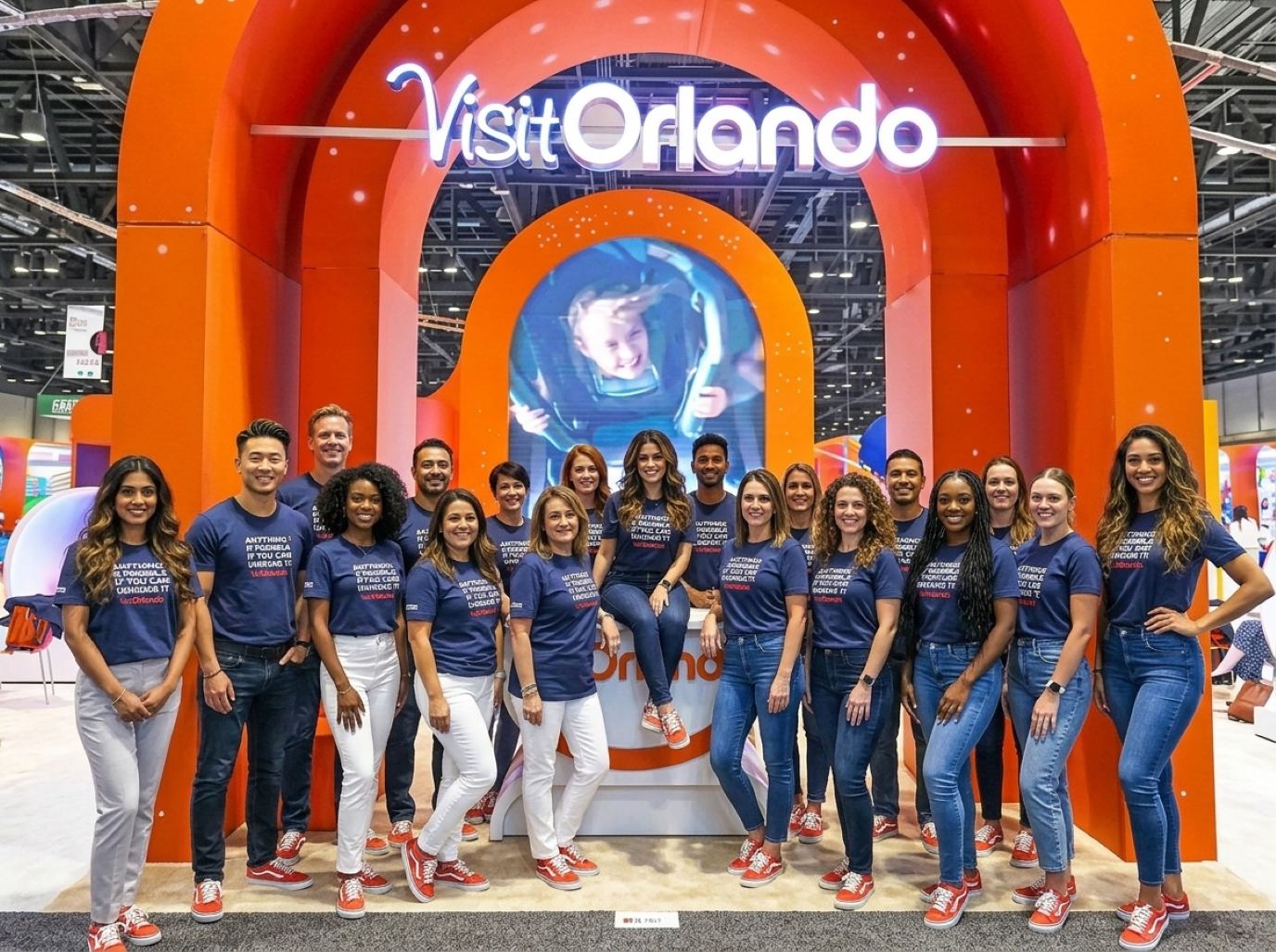
One crew, one look.Navy slogan tees, denim or white trousers and matching red sneakers: a big ambassador team dressed as one so visitors can spot who to ask from across the hall.
Brand ambassadors for trade shows are the people who stand where your booth meets the aisle and turn passing attendees into conversations. They stop people with a question instead of a pitch, tell your story in about thirty seconds, run the giveaway or sampling station by your rules, scan the badge, and hand anyone serious to the salesperson who can close. Purple Exhibits books them in every U.S. convention city at a flat $85 an hour per person, with a four-hour minimum and no travel fees.
An exhibit can be beautiful and still be invisible. Most attendees walk an aisle with their eyes on their phone or the next hall sign, and they pass a booth in a few seconds. A brand ambassador’s whole job is to win those seconds: make eye contact, ask something worth answering, and decide quickly whether this is a person your team wants to meet. Done well, it changes who walks into your booth, not just how many.
Show days follow a pattern almost everywhere: a rush at the doors, a lunch lull, waves when sessions end and a slow afternoon. This is how a brand ambassador works each part of it.
The crew arrives, signs in with your booth captain and walks the space. They find the giveaway stock, the scanner chargers, the literature drawer and the spot where your salespeople stand, so nobody hunts for anything once the hall opens.
A ten-minute run-through with your team. Today’s headline, any product that is out of stock, which executives are on the floor and when, and the one question each ambassador will open with. If the booth has a demo or a talk on a timetable, the times go on a card in every pocket.
The busiest stretch of most show days. Ambassadors take their marks on the open sides, keep the giveaway behind the scan, and pass warm visitors inward fast. The goal in this window is volume without a crowd blocking your own booth.
Traffic settles into a rhythm. This is when ambassadors do their best qualifying: a second question after the opener, a note in the scanner, a proper introduction to the right person on your team instead of a vague wave toward the back.
Aisles thin out as attendees head to food courts and sessions. We stagger breaks here, one person at a time, so the booth edge is never empty. A floater covers the gap on larger crews.
Conference sessions end on the hour or half hour and the aisles refill all at once. Ambassadors know the session schedule and step back onto their marks a few minutes early.
Energy drops across the hall. This is when a good ambassador earns the rate: fresh opening lines, a reset of the sampling table, a walk to the next aisle to invite people toward a demo starting in five minutes.
Giveaways refilled from storage, literature squared up, scanner batteries swapped, trash cleared from counters. A tidy booth at four o’clock pulls more people than a messy one at ten.
Attendees make final rounds and often have a clearer idea of what they want. Ambassadors focus on handoffs and meeting bookings for the next day rather than volume.
A five-minute debrief with your booth captain: what people asked, what ran out, which opener worked. Scanner notes are checked, stock is counted and the booth is locked down the way you asked.
All six of our booth roles cost the same, so pick the one that matches the problem you have. If the issue is that not enough of the right people stop, you need ambassadors. If people stop but leave unsorted, you may need dedicated lead capture staff alongside them.
You need more people to stop, and you want the right ones passed to sales.
Aisle traffic, sampling, giveaways, lines, activationsThis page. The aisle specialists.Visitors already come to you and need a polished welcome, a seat or a meeting room.
Lounges, meeting check-in, VIP greetingTrade show hostess page →The product only makes sense when someone shows it working.
Live demos, presentations, timed loopsProduct demonstrator page →You have traffic but your leads come back thin or unsorted.
Badge scanning, qualifying questions, lead tagsLead capture staff page →A big share of your buyers are more comfortable in another language.
Spanish and other languages, confirmed by nameBilingual booth staff page →You need a camera-ready presence for a launch, a photo wall or media.
Spokesmodels, photo moments, product revealsPromotional model page →Many booths mix roles. A common pattern is one or two ambassadors on the aisle, a product demonstrator running the demo they feed, and a hostess looking after booked meetings in the back. Ambassadors work best when the person they hand to is ready and waiting.
Ambassadors work the open sides, so the count follows your frontage more than your square footage. These are peak-hour numbers; quiet hours can run lighter.
One open side and very little floor. A single ambassador stands at the front corner, opens conversations and steps aside so the visitor can reach your salesperson. Two people in a 10×10 starts to feel crowded unless one of them is your own rep.
Twenty feet of frontage is enough for two ambassadors working each end of the carpet, or one ambassador plus a sampling station. They split the aisle so the traffic coming from both directions hears an opener.
Three open sides means three directions of traffic. Most 20×20s need one ambassador per open side during peak hours, or two plus a counter ambassador running a scan-first giveaway in the middle.
Longer frontage and usually a demo or a counter. Plan two ambassadors on the long side, one on each short side at peak, and a floater who covers breaks and restocks.
Four open sides and traffic from every corner. Islands usually need six to eight ambassadors at peak, split into side teams with a lead ambassador who moves people between the demo, the theater and the lead desk.
Two things change these numbers. A booth on a main aisle or near an entrance sees far more traffic than one in a back corner, so it can use an extra ambassador at peak and still keep each one busy. And anything that draws a line, such as a popular giveaway, a signing or a timed demo, needs its own ambassador so the people on the open sides can keep working the aisle. If you are unsure, start with the lower number for full days and add a peak-hours person for the first morning; a four-hour booking is enough for that.
Before the show, our coordinator turns your materials into a short brief and a pocket card. On the first morning, the crew rehearses it with your team at the booth. These are the nine things every ambassador knows before the doors open.
What you make, who it is for and why it matters this year, in words a stranger understands. We trim your messaging to something an ambassador can say naturally, not recite.
Three facts the ambassador can back up: a feature, a result your marketing team approves, a new thing at this show. Anything beyond those three goes to your team.
One question that starts a real conversation, chosen for your audience. “What brings you to this aisle?” works for some shows. “Do you run a store or a distribution business?” works better at others.
The job titles, company types and regions you care about, and the ones you politely pass on. Ambassadors learn to spot the badge colors and titles that matter.
What visitors must do before the gift changes hands: a badge scan, a short question, a demo seat. We write the rule on a card so it is applied the same way at nine in the morning and five in the afternoon.
Which salesperson takes which kind of visitor, how the ambassador introduces them, and what to do when everyone on your team is busy (book a time, take a note, never let them drift away).
Pricing, competitors, roadmap dates, health or performance claims you have not approved. Ambassadors learn the polite line that sends those questions to your team.
How your lead app or scanner works, the tags you use, and the one-line note format your sales team wants after the show.
Where stock lives, who the booth captain is, break times, dress code, badge pickup, and the show’s floor rules on sampling, sound and aisle space.
What we need from you: your booth plan, a few lines on the product and the audience, your giveaway rule, the lead app login steps and the name of your booth captain. A thirty-minute call two weeks out covers the rest.
Good brand ambassadors are not the loudest people in the hall. They are the ones visitors are glad they stopped for. These five things decide who we put on your aisle.
We look for people who are comfortable starting a chat with a stranger and listening to the answer. Confidence on the aisle matters more than a polished delivery.
A crew for a contractor show is not the crew for a beauty launch. We match each ambassador’s background and manner to the people walking your aisle, so the first exchange feels natural to the visitor.
Ambassadors have one call and one morning to learn your story. We book people who pick up a product brief fast and know where their knowledge stops.
Shows run eight to ten hours on hard floors. We choose people who are as warm in the last hour as in the first, and we plan breaks so they stay that way.
We book ambassadors who live near the venue whenever we can. That keeps travel off your invoice and puts standby people within easy reach.
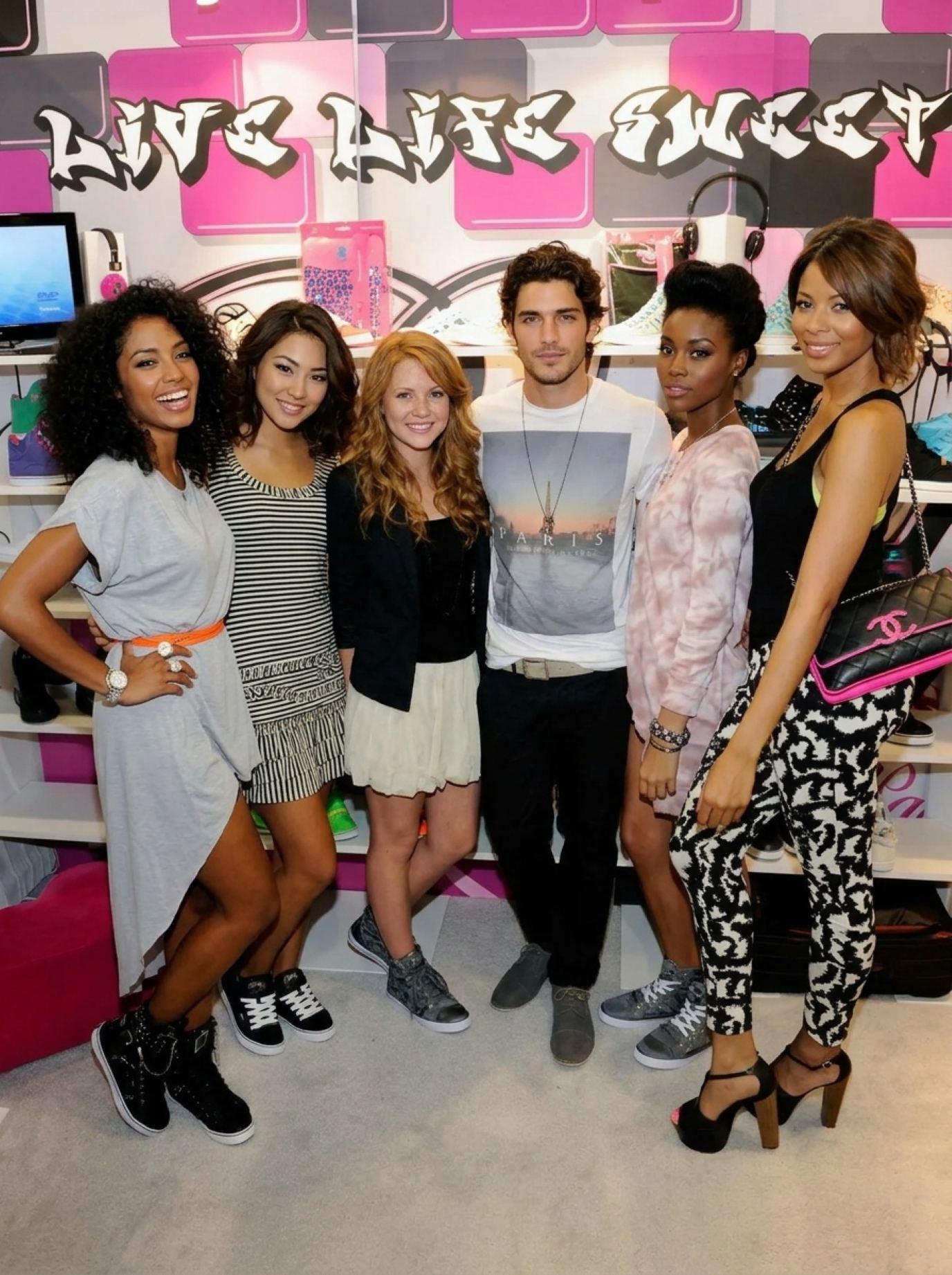
Ambassador crews from real Purple Exhibits booths. Friendly, easy to approach, dressed so visitors know exactly who to ask.
Top of the page · Big team, one look. The large crew in navy slogan tees and red sneakers shows what a matching look does for a busy booth: every ambassador is easy to find.
Each crew is briefed on your story, your giveaway rule and your handoff before the first visitor walks in.
Book an ambassador crewReal Purple Exhibits events.
The right look depends on your audience and the job each person does. Dress the whole crew alike, or put sampling staff in aprons and the aisle team in logo tees.
A fitted branded tee, dark or mid-wash jeans and clean sneakers. The street-team classic for consumer shows, fan events and youthful brands.
Best for: Aisle work, activationsA brand-color polo with black or khaki trousers and comfortable closed shoes. Reads friendly and professional in industrial, trade and technical halls.
Best for: Scan-first giveaways, B2B aislesA plain knit or blouse, a soft blazer and tailored trousers. Right when buyers are senior and the booth is quieter, and easy to dress up for an evening event.
Best for: Executive aisles, receptionsA light shirt with a dark apron, hair tied back. Built for food, beverage and pet treat sampling where hygiene is part of the look.
Best for: Sampling stationsYour own uniform from head to toe: jackets, caps, matching sneakers. Send pieces with sizes two weeks out and we fit every ambassador before the show.
Best for: Launches, big crewsWhatever the look, we confirm shoes, hair, badge position and lanyard color with every ambassador. Shoes matter most: ambassadors stand all day on concrete under carpet, so we pick comfortable closed shoes that still match the outfit. Tell us if your brand has rules on jewelry, nails or visible logos from other companies.
Start from the number of badge scans you want for the whole show. Set your show days, hours and how busy your aisle is, and the estimator sizes the crew, prices it at $85 an hour and shows the cost per scan.
How it works. Each ambassador holds a number of short conversations per hour, set by how busy your aisle is. Some of those end in a scan. The estimator divides your goal by that rate, spreads it over your days and hours, and rounds up.
Breaks and floaters. On crews of four or more it adds one floater per four ambassadors, so breaks never leave a side empty. Floaters and sampling staff are billed but not counted in the scan projection.
Use your own numbers. If you have scan counts from last year’s show, set the pace and share to match them. The figures here are planning starting points, not a guarantee of results.
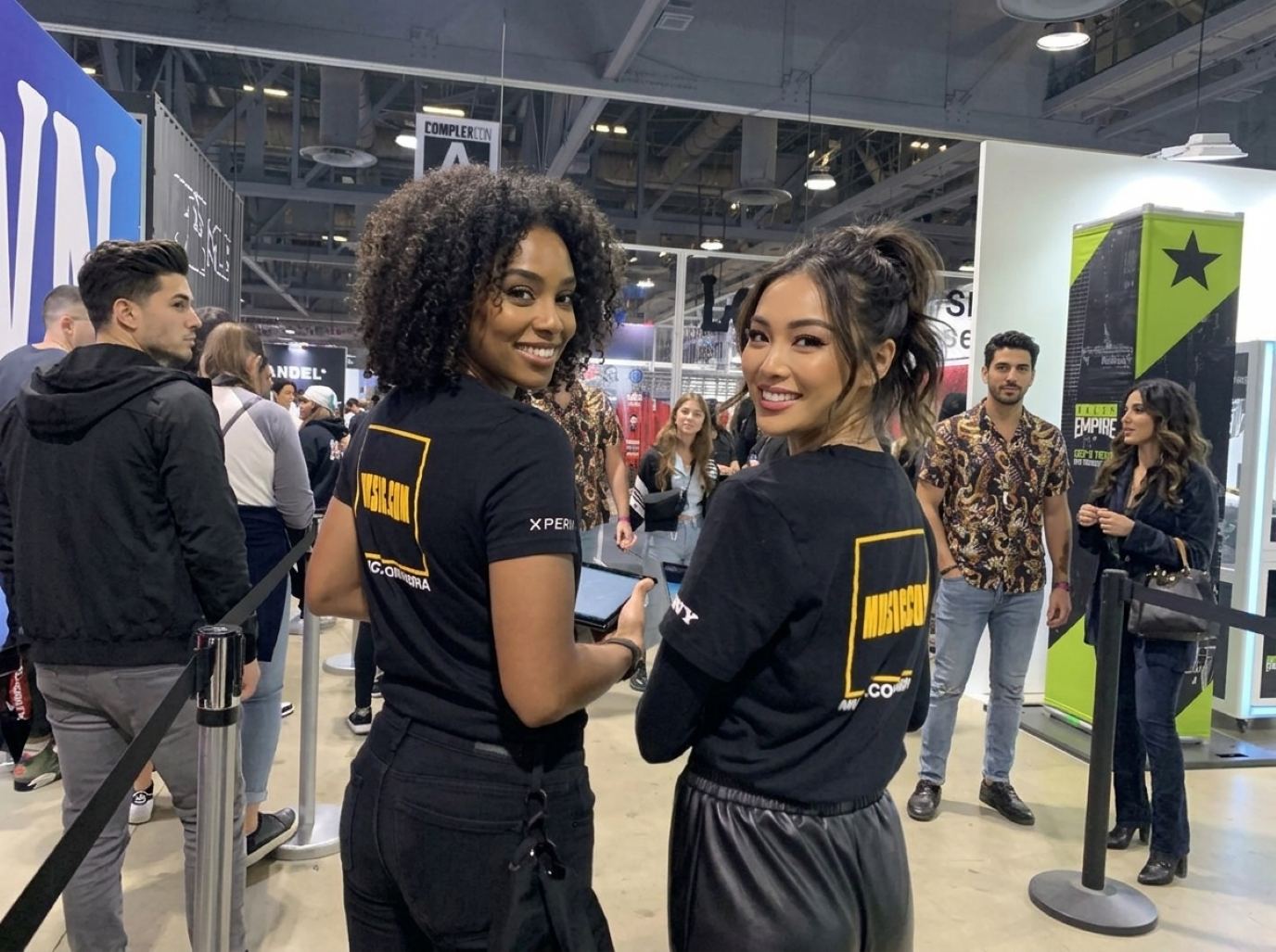
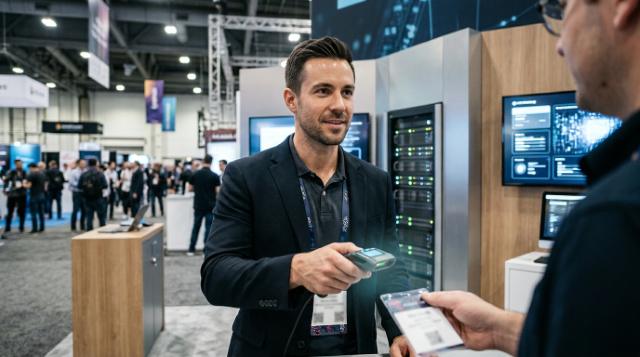
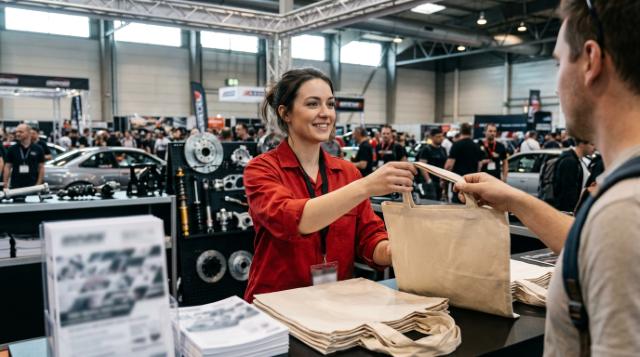
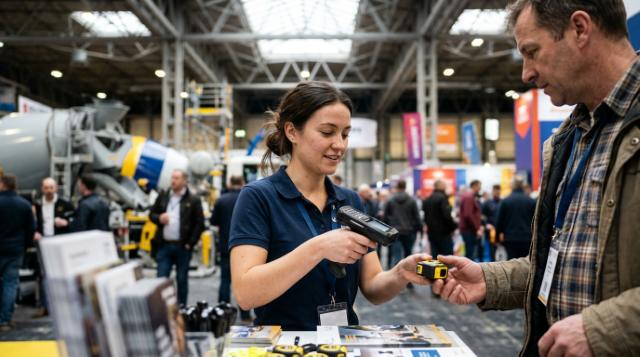
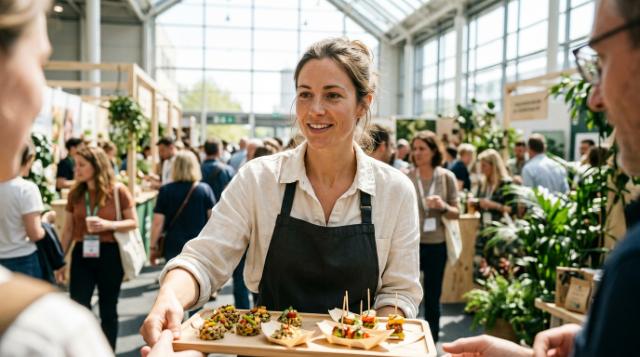
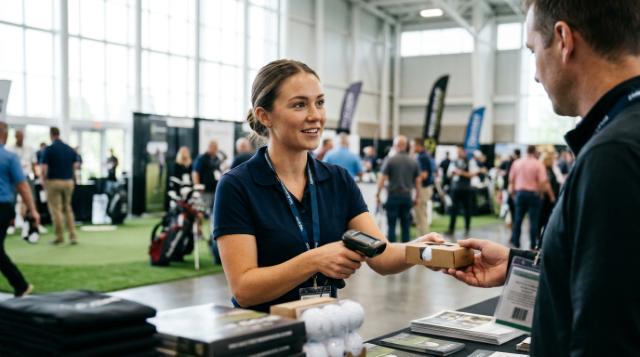
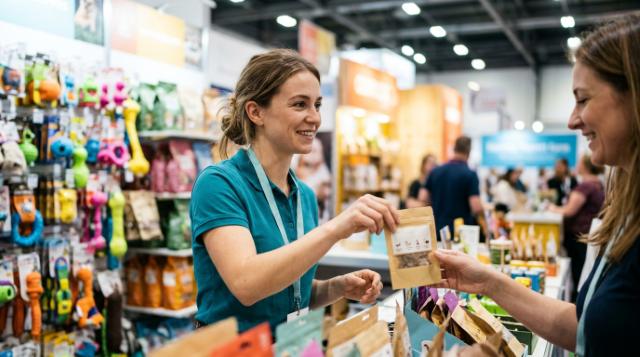
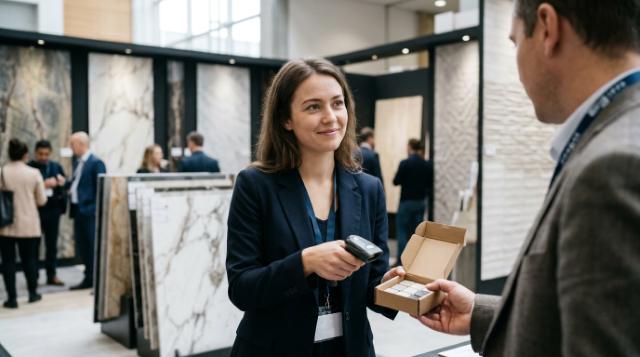
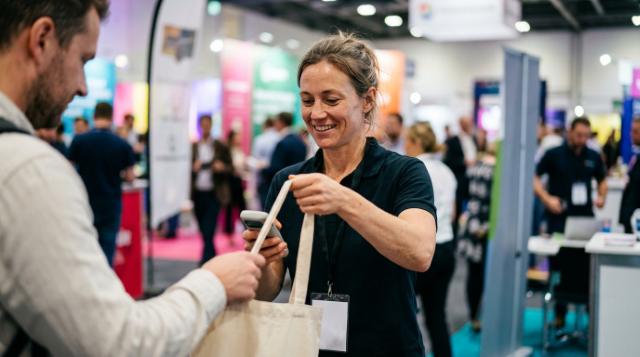
The same job in eight different halls: open the conversation, scan the badge, hand over the sample or the gift, send the visitor on to the right person.
Notice the pattern in every shot: the ambassador stands at the edge of the booth, turned toward the aisle, and the gift or sample changes hands at the same moment as the scan. That one habit is most of what separates a crew that builds your pipeline from one that just empties your giveaway boxes.
A pile of scans is not a result. These six measures show whether your ambassadors brought the right people in and passed them on properly. Agree on them before the show so the crew knows what matters to you.
| Measure | What it tells you | Where it comes from |
|---|---|---|
| Badge scans per ambassador hour | Total scans divided by ambassador hours. Track it by day and by time block, not just as a show total, so you can see when the aisle was strongest. | From your lead app export |
| Conversation-to-scan share | How many conversations ended in a scan. A share that drops means the opener is pulling the wrong people or the giveaway is going out unscanned. | Ambassador tally plus scans |
| Handoffs to sales | Visitors introduced by name to a salesperson. This is the number that tells you whether ambassadors are feeding your team or just collecting badges. | Tag in the scanner |
| Meetings booked | Follow-up calls or next-day booth meetings set by the ambassador when your team was busy. | Calendar or note tag |
| Gifts per scan | Giveaway items handed out divided by scans. Close to one means your scan-first rule is holding. | Stock count at close |
| Note quality | Pick twenty leads at random after the show. Can a salesperson follow up from the note alone? If not, tighten the note format for next time. | Post-show spot check |
Set targets from your own history, not from someone else’s show. A medical device booth and a beverage booth will never produce the same scan rate, and they should not. What you want is improvement against your last show, a clean handoff count and notes your sales team actually uses. Our coordinator checks in with your booth captain each day and adjusts the crew if the numbers say so: moving someone to a busier side, changing the opener or tightening the giveaway rule.
Almost every disappointing ambassador booking traces back to one of these. All eight are cheap to prevent before the show.
Ambassadors reach for every lanyard to hit a number, and sales gets hundreds of scans from students and other exhibitors.
Set a target for handoffs, not just scans, and give ambassadors two or three titles to pass on politely.
A crowd forms around free items and nobody asks for the badge until the stock is gone.
Write a scan-first rule, keep the stock behind the counter and let the ambassador hand it over only after the scan.
Three ambassadors standing in a row across the front look like a wall, not an invitation.
Mark spots at the corners and edges, angled toward the aisle, with clear space for visitors to walk in.
A forty-second script delivered at speed sends people away. It sounds like a recording.
We brief on ideas, not lines. Each ambassador puts the story in their own words and rehearses it with your team.
Ambassadors bring in a good visitor and every salesperson is busy, so the visitor wanders off.
Agree on a fallback: book a slot, take a phone number, or bring them to a seat with water and a brochure.
Everyone goes to lunch together and the booth edge is empty during the next session break.
Staggered breaks on a written rota, plus a floater on crews of four or more.
By day three the line feels stale to the crew, and it shows.
Refresh the opener each morning in the huddle with what worked yesterday.
The show ends and nobody writes down what visitors asked about most.
A five-minute wrap each evening, and a short summary from our coordinator after the last day.
Same people, same rate, different brief. Most exhibitors book one or two of these; bigger launches combine several.
The core job: openers, quick qualifying, scans and handoffs at the open sides of your booth. They keep moving along the edge so the booth never looks guarded, and they step back the moment a visitor wants to walk in.
Food, beverage, beauty and pet treat sampling, run by the show’s rules for portions, gloves and allergen cards. They keep the table stocked and tidy and use every taste as a chance to ask one qualifying question.
A scan-first counter for swag that draws a line: totes, hoodies, tape measures, ball sleeves, sample boxes. They keep stock behind the counter and the line short, so the giveaway brings leads instead of crowds.
Signings, popular demos and photo walls. They keep the line moving, keep the aisle clear for neighbors and fire marshals, give realistic wait times and scan everyone in the line.
Pop-ups, outdoor activations and pre-show street teams near the convention center or the host hotels, inviting people to the booth with a card, a code or a reason to visit.
Customer parties, receptions and hospitality suites: guest list, wristbands, photo moments and a warm goodbye. Often the same people who worked your booth that day, so guests see a familiar smile.
Running a launch with a photo wall or media hour? Pair your ambassadors with promotional models and spokesmodels. Expecting buyers who prefer Spanish or another language? Our bilingual booth staff page explains how we confirm language skills by name before booking.
One rate for every ambassador, every show and every city. You pay for hours on the floor and nothing else.
| Typical booking | Cost |
|---|---|
| One ambassador, half day1 person × 4 hours | $340 |
| One ambassador, full show day1 person × 8 hours | $680 |
| Two ambassadors, three-day show2 people × 8 hours × 3 days | $4,080 |
| Three ambassadors on a 20×20, four days3 people × 9 hours × 4 days | $9,180 |
| Island crew of six, three days6 people × 8 hours × 3 days | $12,240 |
| Street team before the show4 people × 4 hours, one evening | $1,360 |
Every line is people × hours × $85. Hours are counted from crew call to release, so include the hour before doors when you plan. The estimator above prices any other combination.
Why one rate? Because the cheapest way to staff a booth is to book the right role for each job, and a price list with a premium on every title pushes exhibitors toward the wrong person. With one flat $85 rate, you can put an ambassador on the aisle, a demonstrator on the demo and a lead specialist on the scanner without doing sums for each. There is no extra charge for a sampling station, an early call, a uniform you provide or a language other than English.
Show name, dates, booth number and size, and roughly how many scans or conversations you want. The estimator on this page is a good starting point.
A written quote within one business day: crew size, hours per person, total at $85 an hour, and the look we suggest.
A thirty-minute call about two weeks out. We turn your materials into a pocket card, confirm the outfit and send names for badges.
The crew arrives an hour before doors, rehearses with your team and works the aisle. Our coordinator checks in daily and handles any swap.
We book ambassadors wherever exhibitors go. The busiest requests come from Las Vegas, Orlando and Chicago, so start with our brand ambassadors in Las Vegas, Orlando brand ambassadors, Chicago booth ambassadors, New York brand ambassadors, and ambassadors for Anaheim and Los Angeles shows. On the show side, ambassadors are booked most for SEMA Show ambassadors, CES brand ambassadors, sampling ambassadors at Expo West, and SuperZoo ambassadors, where giveaway lines and sampling tables need constant attention.
Not on the list? We staff any U.S. convention center, hotel or outdoor venue at the same rate. See all locations or the full trade show staffing overview.
About three minutes. No deposit to ask.
We’ll email your quote within 24 hours, usually much sooner. Need it now? Call (800) 994-8030.
Call (800) 994-8030 and ask for the ambassador desk.
$85 per hour per person, with a four-hour minimum for each booking. The rate is the same for every role we staff, and there are no travel fees anywhere in the U.S. One ambassador for an eight-hour show day costs $680.
They work the open edges of your booth: they start conversations with people walking past, explain what you do in about thirty seconds, run the giveaway or sampling station by your rules, scan badges and introduce serious visitors to your sales team.
A promotional model is booked mainly for presence and photos. A brand ambassador is booked to talk, qualify and hand off. Many people can do both, but the brief and the measure of success are different.
Plan one per open side at peak hours: one for a 10×10, one or two for a 10×20, two or three for a 20×20 and six to eight for a large island. Add a floater on crews of four or more to cover breaks. The estimator on this page works it out from your lead goal.
Yes. They learn your lead app or scanner before the show, use your tags and write a short note on each lead in the format your sales team asks for.
Yes. Sampling ambassadors follow the show’s rules on portion sizes and serving, wear gloves and an apron when food is involved, and keep allergen or ingredient cards at the table. Some cities and shows require a food handler card; tell us and we book people who hold one.
Whatever suits your brand: a logo tee and denim, a branded polo, smart casual, a sampling apron or your own uniform. Send uniform pieces with sizes about two weeks out and we fit everyone before the show.
Yes. We book ambassadors in every major U.S. convention city, from New York and Chicago to Seattle, Denver and Miami, and the rate and the no-travel-fee rule stay the same.
Two to four weeks gives you the widest choice and time for a proper briefing. For the biggest show weeks, book earlier. Rush crews are possible with 72 hours’ notice.
We keep standby people on call during the show. If a replacement who has read your brief is not at your booth within two hours, that shift is free.
Yes. Book a single show day, a peak block such as opening morning, or an evening event. Each person has a four-hour minimum.
Yes. We staff street teams, pop-ups, hotel lobbies, customer parties and hospitality suites during show week, at the same rate.
Spanish is the language exhibitors ask for most. Other languages are on request, and we confirm the person by name before we book. See our bilingual booth staff page for details. There is no language surcharge.
We aim to keep the same people for the whole show so the briefing carries through. If a change is needed, the replacement reads your brief and gets a handover from the crew.
Yes. We design, build and rent exhibits and staff them under one plan, so the giveaway counter, the sampling table and the open sides are placed with your ambassadors in mind.
Send your show, booth size and lead goal. A brand ambassador quote within 24 hours.
Let’s get right on that answer for you: